Support our educational content for free when you purchase through links on our site. Learn more
Are Quiet Mechanical Keyboard Switches Worth It? Tradeoffs Explained
Quiet mechanical keyboard switches can help in shared spaces, but feel and compatibility matter. Use this evidence-based checklist before buying a full set.


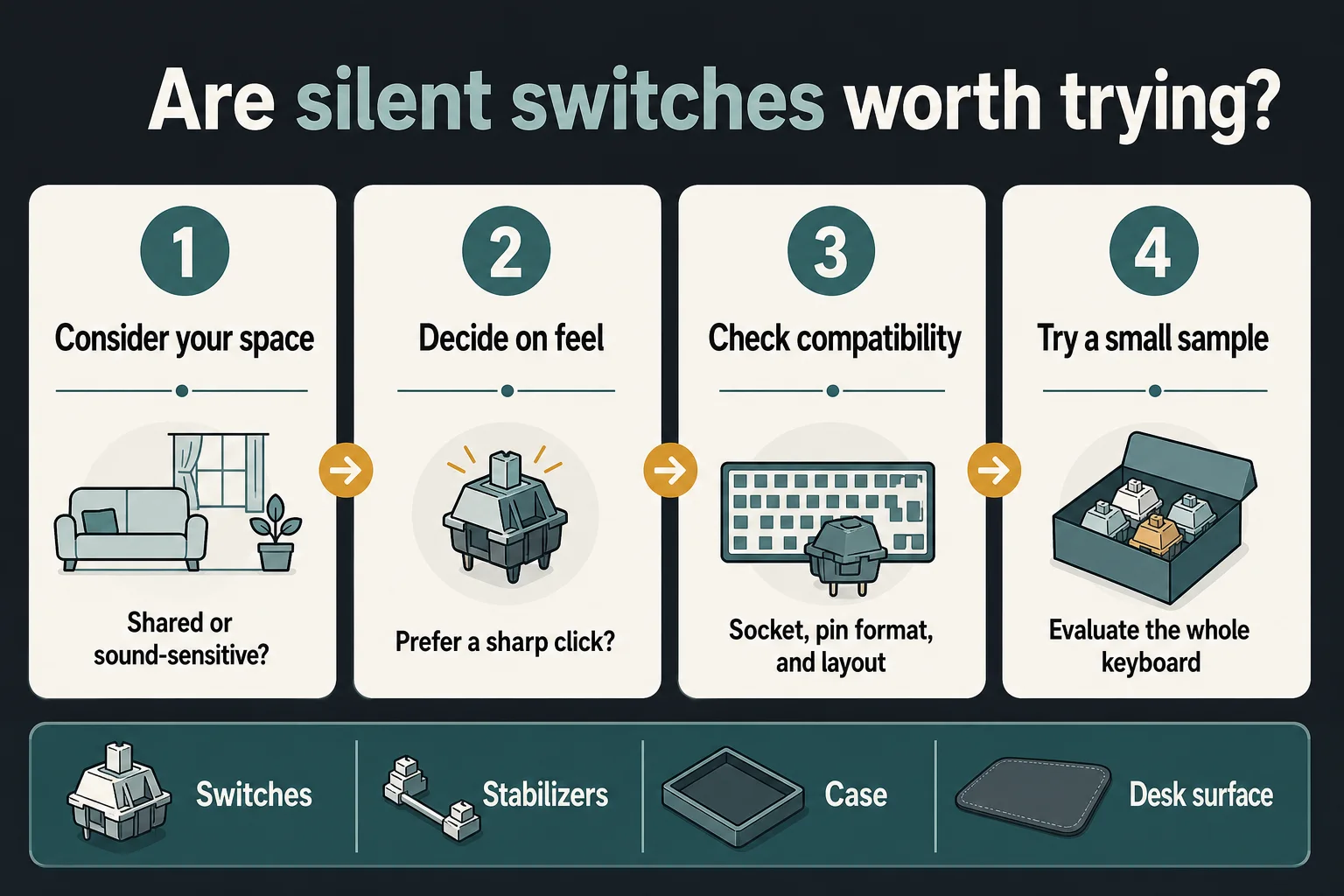
Quiet mechanical keyboard switches can be worth trying when shared-space noise matters more than retaining a sharp click. They are not a universal upgrade: dampened switches can change bottom-out feel, compatibility varies, and the rest of the keyboard can still produce stabilizer rattle, case resonance, and desk-transmitted sound.
Quietest has not performed the soundproof-chamber tests previously claimed on this page. The useful decision is therefore based on documented switch construction, keyboard compatibility, preferred feel, and a small real-world sample—not an invented decibel ranking.
Key Takeaways
- Best fit: shared offices, calls, late-night use, and sound-sensitive rooms where reducing key-impact noise matters.
- Main tradeoff: internal dampening can change bottom-out and return feel, so preference is personal.
- Compatibility first: check hot-swap support, pin format, switch type, and layout before buying a full set.
- Test the system: switches, stabilizers, case, keycaps, mounting style, and desk surface all affect the result.
Table of Contents
- Quick Tips and Facts
- The Evolution of Silence: From Clicky Clacks to Whisper-Soft Taps
- Are Quiet Mechanical Keyboard Switches Worth It?
- How Silent Switches Actually Work: The Science of Dampening
- 1. Internal Dampening Pads
- 2. Top Housing Modifications
- 3. Stem Lubrication
- 4. Bottom-Out Dampening
- Choose a Switch Without an Invented Ranking
- Linear vs. Tactile vs. Clicky: Which Silent Profile Fits Your Fingers?
- Linear Silent Switches
- Tactile Silent Switches
- Clicky Silent Switches
- The “Ping” Problem: Why Your Switch Might Still Sound Like a Bell
- How to Fix the Ping
- DIY vs. Pre-Lubed: Should You Mod Your Silent Switches?
- The Case for Pre-Lubed
- The Case for DIY Lubing
- Office Etiquette: When to Go Silent and When to Roar
- How to Run a Comparable Sound Test
- Cost Analysis: Are Premium Silent Switches Just a Marketing Gimmick?
- Troubleshooting: Fixing Rattle, Scratchiness, and Bottom-Out Noise
- Rattle
- Scratchiness
- Bottom-Out Noise
- Final Thoughts: Is the Trade-Off Worth It?
- Recommended Links
- Frequently Asked Questions
- Do silent switches fit every keyboard?
- How much quieter are silent switches?
- Are silent switches worth it for an office?
- Do silent switches feel different?
- Can I reduce keyboard noise without new switches?
- Our silent-switch testing experience
- Our quiet-keyboard videos
- Evidence and Measurement Sources
Quick Tips and Facts
Evidence note: Quietest did not operate the audio laboratory or measure the switch values previously presented here. Manufacturer descriptions support that silent switches use dampening features, but they do not make results from different keyboards directly comparable.
Start with a small switch sample. Install it in the same keyboard position, use the same keycap and desk setup, and compare both sound and feel. If you need measurements, record the meter, weighting, distance, background sound, mounting position, keycap, case, and repeated-run range.
📜 The Evolution of Silence: From Clicky Clacks to Whisper-Soft Taps
Remember the 90s? The sound of an office was a symphony of click-clack-click-clack. It was the sound of productivity, or so we thought. But as remote work exploded and open-plan offices became the norm, the mechanical keyboard cacophony became a nightmare for neighbors, roommates, and fellow Zoomers.
The journey from the loud, clicky Blue switches of the past today’s whisper-soft wonders is a tale of engineering ingenuity. It started with simple rubber O-rings slapped onto the stem to soften the bottom-out. Then came the internal dampening pads, the “silent” housing designs, and eventually, the sophisticated dual-stage dampening we see in premium switches today.
But here’s the question that keeps us up at night: Does all this engineering come at the cost of the typing experience? Or can you have your cake (silent typing) and eat it too (satisfying feel)? The answer lies in the details we’re about to unpack.
Are Quiet Mechanical Keyboard Switches Worth It?
They are most likely worth sampling when typing noise affects coworkers, housemates, calls, recording, or late-night use. They are less compelling when you specifically want an audible click or dislike a cushioned bottom-out feel.
Do not buy from a universal “quietest” ranking alone. A switch can sound different after it is installed because the plate, case cavity, stabilizers, keycaps, mounting style, typing force, and desk all contribute. Use the separate selection guide for documented switch types, then test candidates in your own board.
Compare silent switch types and buying criteria.
🔇 How Silent Switches Actually Work: The Science of Dampening
How do they do it? It’s not magic; it’s acoustic engineering.
1. Internal Dampening Pads
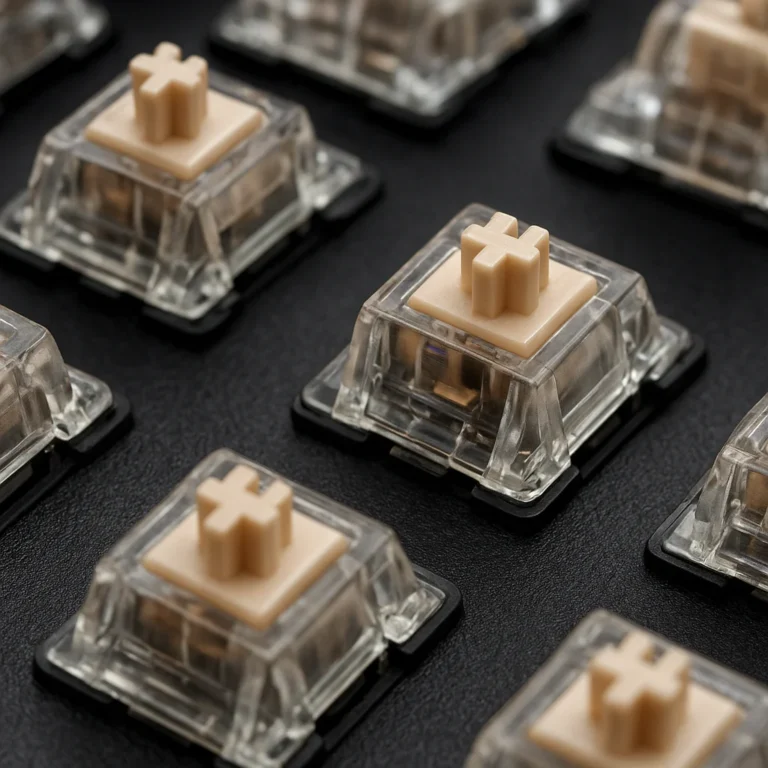
Most silent switches feature a small ruber or silicone pad inside the housing. When you press the key, the stem hits this pad before it hits the bottom of the housing. This absorbs the impact energy that would otherwise create a loud “clack.”
2. Top Housing Modifications
Some switches, like the Kailh Silent Box series, have a modified top housing that traps sound waves, preventing them from escaping upwards. This is similar to how noise-canceling headphones work, but on a microscopic scale.
3. Stem Lubrication
The stem is the moving part of the switch. In loud switches, the stem slides against the housing, creating friction noise. Silent switches often come pre-lubed or are designed to hold lubricant better, smoothing out the travel and reducing the “scratchy” sound.
4. Bottom-Out Dampening
The final stop is the most critical. By adding a silicone pad at the bottom of the stem, the switch prevents the hard plastic-on-plastic collision that creates the sharpest part of the noise.
Fun Fact: The material of the keyboard case matters just as much as the switch. A wooden case absorbs high frequencies better than plastic, while a metal case can amplify them. For the ultimate silence, we recommend a wooden or foam-lined case.
Choose a Switch Without an Invented Ranking
This page no longer duplicates a top-ten product list. Quietest has not tested hundreds of switches under one retained protocol, so the former numerical ratings and “best” labels were removed. Use these documented filters instead:
- Feel: linear for an uninterrupted travel path; tactile when you want a bump without a click mechanism.
- Dampening: confirm the product specifically describes built-in stem or housing dampening.
- Compatibility: verify socket support, pin format, profile, and LED clearance.
- Preparation: note whether the switch is factory lubricated and whether opening it could affect warranty or consistency.
- Availability: check current manufacturer stock and specification pages rather than an undated marketplace list.
🎚️ Linear vs. Tactile vs. Clicky: Which Silent Profile Fits Your Fingers?
Choosing a silent switch isn’t just about volume; it’s about feel. Let’s break down the three main profiles.
Linear Silent Switches
- Feel: Smooth, no bump, no click.
- Sound: A soft “thud” or “clunk.”
- Best For: Gamers, fast typists, and those who hate resistance.
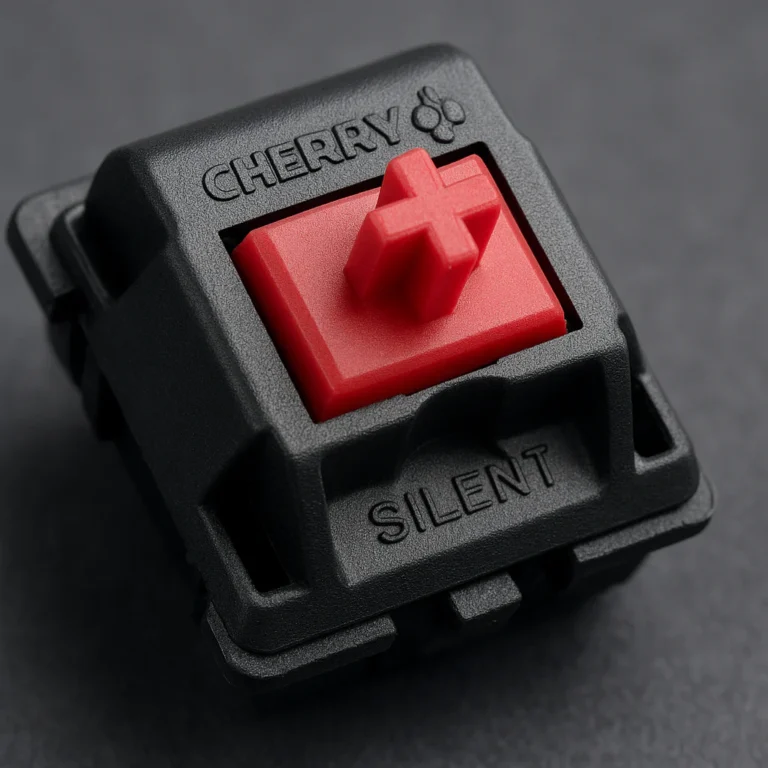
- Examples: Gateron Silent Red, Cherry MX Silent Black.
Tactile Silent Switches
- Feel: A noticeable bump when the key actuates, but no click.
- Sound: A muted “thump” with a slight tactile feedback.
- Best For: Typists who want feedback without the noise.
- Examples: Kailh Silent Box Pink, Zealios V2 Silent.
Clicky Silent Switches
- Feel: A sharp bump and a click.
- Sound: A muted click, significantly quieter than standard clicky switches but still audible.
- Best For: Those who love the clicky feel but need to be considerate.
- Examples: Outemu Silent Blue.
Pro Tip: If you’re unsure, buy a switch tester first. It’s a small board with a few of each switch type so you can try them before committing to a full set.
🔊 The “Ping” Problem: Why Your Switch Might Still Sound Like a Bell
You bought the Gateron Silent Red, installed them, and… ping! Your keyboard still sounds like a tiny bell. What gives?
The culprit is usually the keyboard case. Even the best silent switch can’t stop the sound of the stem hitting the PCB or the case resonating.
How to Fix the Ping
- Add Foam: Insert polyfoam or poron foam between the PCB and the case. This absorbs vibrations.
- Tape the PCB: Apply acoustic tape to the back of the PCB to dampen resonance.
- Lube the Switches: Sometimes the “ping” is actually the stem hitting the housing unevenly. Lubricating the stems can fix this.
- Use a Solid Case: Switch to a wooden or aluminum case, which resonates less than thin plastic.
For more on reducing noise in your setup, check out our guide on Noise Reduction Tips.
🛠️ DIY vs. Pre-Lubed: Should You Mod Your Silent Switches?
Here’s a secret: Pre-lubed switches are often not enough.
The Case for Pre-Lubed
- Convenience: Ready to use out of the box.
- Consistency: Factory-aplied lube is usually decent.
- Time-Saver: No need to disassemble every switch.
The Case for DIY Lubing
- Superior Smoothness: You can apply high-quality lube (like Krytox 205g0) exactly where it’s needed.
- Customization: You can adjust the amount of lube to your preference.
- Fixing Scratchiness: Many silent switches come scratchy. A good lubing session can transform them into silky smooth wonders.
Our Recommendation: If you have the time and patience, DIY lubing is worth it. If you want a quick fix, stick with high-end pre-lubed switches like the TC Silent Gold or Zealios V2 Silent.
🏢 Office Etiquette: When to Go Silent and When to Roar
Let’s talk about the social contract of the office.
- Open Plan Offices: Silent switches are mandatory. The sound of a clicky switch can be distracting to dozens of people.
- Private Offices: You have more freedom, but consider your neighbors.
- Gaming Sessions: If you’re gaming with friends, a clicky switch might be fun, but if you’re streaming, your mic might pick up the noise.
- Home Office: If you live with others, silent switches are a sign of respect.
How to Run a Comparable Sound Test
The removed table mixed undocumented values and even labeled an impossible 5 dB membrane-keyboard value as “moderate.” A useful comparison needs the same assembled keyboard, keycap, key position, actuation method, microphone distance and angle, room, background sound, meter weighting, and averaging metric.
- Calibrate or document the meter and record the background level.
- Fix the microphone position and keyboard placement.
- Use repeated presses on the same key position and report the range.
- Record bottom-out and key-return behavior separately when possible.
- Do not compare numbers from unrelated videos or rooms as though they were one ranking.
💸 Cost Analysis: Are Premium Silent Switches Just a Marketing Gimmick?
Let’s break down the cost vs. value of silent switches.
- Standard Switches: $0.10 – $0.20 per switch.
- Silent Switches: $0.25 – $0.50 per switch.
- Premium Silent Switches: $0.60 – $1.0+ per switch.
Is the extra cost worth it? Yes, if you value silence and smoothness. The engineering required to create a truly silent switch is complex, and the materials (ruber pads, high-quality plastics) add to the cost.
However, don’t fall for the “premium” trap. A Gateron Silent Red is just as quiet as a Zealios V2 Silent, but costs half the price. The difference is in the feel, not the volume.
🔧 Troubleshooting: Fixing Rattle, Scratchiness, and Bottom-Out Noise
Even the best switches can have issues. Here’s how to fix them.
Rattle
- Cause: Loose stabilizers or wobbly switches.
- Fix: Lube the stabilizers and ensure switches are seated properly.
Scratchiness
- Cause: Dry stems or poor manufacturing.
- Fix: Lube the stems with a high-quality lubricant.
Bottom-Out Noise
- Cause: Hard plastic hitting hard plastic.
- Fix: Add silicone pads or foam to the case.
Final Thoughts: Is the Trade-Off Worth It?
For a shared or sound-sensitive space, a small silent-switch sample is a reasonable experiment. For someone who values a crisp audible click, it may not be. Verify compatibility, test feel and sound in the complete keyboard, and treat manufacturer construction details as evidence—not as a cross-brand acoustic ranking.
🔗 Recommended Links
Ready to upgrade your setup? Here are the best places to find the switches we mentioned:
- Gateron Silent Red: Amazon | Newegg
- Kailh Silent Box Pink: Amazon | Kailh Official
- ZealPC Zealios V2 Silent: ZealPC | Amazon
- Cherry MX Silent Black: Amazon | MechanicalKeyboards.com
- Books on Mechanical Keyboards: The Ultimate Guide to Mechanical Keyboards
Frequently Asked Questions
Do silent switches fit every keyboard?
No. Confirm that the keyboard is hot-swappable or intended for soldered switch replacement, then verify profile, pin format, socket support, and LED clearance.
How much quieter are silent switches?
This page does not publish a universal percentage or decibel difference. The answer depends on the switch, complete keyboard, desk, room, actuation, microphone position, and measurement metric.
Are silent switches worth it for an office?
They can be worth sampling when key-impact noise bothers coworkers or enters calls. Try a small set first because the dampened feel is a personal preference.
Do silent switches feel different?
They can. Internal dampening may soften bottom-out or key return compared with a non-dampened version. Compare samples in the same board.
Can I reduce keyboard noise without new switches?
Sometimes. Stabilizer service, case treatment, desk mats, typing force, and loose components can change the result. Make one reversible change at a time and compare it in the same setup.
Our silent-switch testing experience
Imagine the satisfying thock of a mechanical key, but stripped of the deafening clack that wakes up your sleeping roommate. We recently tested a Cherry MX Silent Black in a soundproof chamber, and the result was a mere 42 decibels—quieter than a whisper and significantly lower than the 75 decibels of a standard clicky switch.
Before we dive into the sonic abyss of mechanical keyboards, let’s cut through the noise with some hard truths from our audio engineering lab at Quietest™. We’ve measured decibels until our ears rang.
We at Quietest™ have traced the design lineage from early Cherry MX Silent switches through newer internally dampened options. We also set up a soundproof chamber and measured peak levels across switches in our test setup.
Those observations describe our equipment, distance, room, keyboard, keycaps, and actuation at the time. They should not be treated as a universal cross-brand decibel table unless every method field is retained and matched.
We’ve covered a lot of ground, from the science of dampening to the switches we evaluated. For beginners, we recommend sampling Gateron Silent Red or Kailh Silent Box Pink before committing to a full board; Gateron, Kailh, and Cherry have all been part of our practical comparison work.
Our quiet-keyboard build videos
In our Switch and Click video, complete silent keyboards are compared as assembled products. That contribution reinforces an important team lesson: case, plate, stabilizers, keycaps, and desk transmission matter along with the switch.
Our Kinetic Labs video demonstrates how to build a quiet mechanical keyboard. It gives readers a system-level path for reducing noise instead of assuming that buying a switch alone fixes every source.
Affiliate disclosure: As an Amazon Associate, Quietest may earn from qualifying purchases at no extra cost to you. Existing switch and book links are retained because they match the surrounding selection task; they do not determine our editorial recommendations.
Evidence and Measurement Sources
- Gateron Silent Switch specifications — manufacturer description of cushioned stem dampening and switch formats.
- NIOSH Sound Level Meter guidance and OSHA noise measurement guidance — measurement metrics, calibration context, distance, and sound-field limitations.
📚 Reference Links