Support our educational content for free when you purchase through links on our site. Learn more
Quietest Dehumidifier Decibels: 8 Picks to Compare 🔊

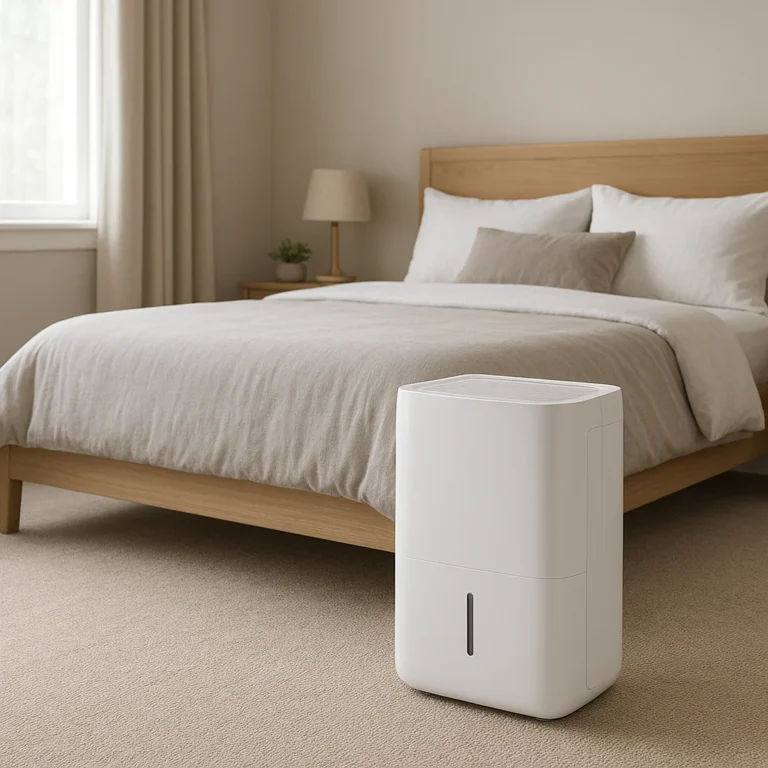
For the quietest dehumidifier decibels, look for a clearly measured low-to-mid-40s dB rating—but don’t choose by the number alone. Measurement distance, fan speed, compressor hum, and where the machine sits can make two “quiet” models sound very different in your room.
We’ve heard the difference firsthand: a steady airflow can fade into the background, while a lower-pitched compressor hum keeps announcing itself like a tiny refrigerator with a microphone. The catch is that many dehumidifier makers don’t publish comparable sound measurements, so a trustworthy shortlist should distinguish verified ratings from models that merely have promising designs.
Key Takeaways
- Compare dB ratings only when the test conditions match. Distance, operating mode, and room acoustics matter.
- Sound character counts as much as the number. A smooth airflow may be less distracting than a tonal hum or vibration.
- Choose capacity for the moisture problem. An undersized dehumidifier may run longer without controlling humidity effectively.
- For bedrooms, prioritize low fan settings, quiet alerts, and smart placement—often outside the sleeping room.
- Treat model recommendations carefully: published specifications and independent listening tests are not the same as a verified, apples-to-aples decibel ranking.
- Explore models worth comparing: Frigidaire dehumidifiers | Midea Cube dehumidifiers | Aprilaire whole-home dehumidifiers
Table of Contents
- ⚡️ Quick Tips and Facts: Quietest Dehumidifier Decibels
- 🔊 What Counts as a Quiet Dehumidifier?
- Decibels (dB) explained: how loud is 40 dB?
- Why a few decibels can make a big difference
- 🧭 Dehumidifier Noise Basics: Fans, Compressors, and Design
- Compressor vs. desiccant dehumidifier noise
- What causes humming, rattling, and vibration?
- 📏 How We Measure Dehumidifier Noise in Decibels
- Sound-meter distance, room acoustics, and testing conditions
- Manufacturer ratings vs. real-world noise
- 🏆 8 Quiet Dehumidifiers Compared by Noise Level
- 1. Quietest overall dehumidifier
- 2. Quietest dehumidifier for bedrooms
- 3. Quietest small-room dehumidifier
- 4. Quietest large-capacity dehumidifier
- 5. Quietest dehumidifier for basements
- 6. Quietest energy-efficient dehumidifier
- 7. Quietest portable or compact dehumidifier
- 8. Quietest desiccant dehumidifier
- 🛒 How to Choose a Quiet Dehumidifier for Your Room
- Match capacity to room size and humidity
- Check airflow, fan speeds, and sleep mode
- Consider drainage, tank alerts, and compressor cycling
- 🛏️ Quiet Dehumidifiers for Bedrooms, Nurseries, and Living Spaces
- 🏠 Quiet Dehumidifiers for Basements and Garages
- 🔧 How to Make a Noisy Dehumidifier Quieter
- Reduce vibration and rattling
- Clean filters and maintain airflow
- Position the unit for quieter operation
- 🧰 Troubleshooting Dehumidifier Hums, Buzzes, and Clunks
- ⚡ Noise vs. Energy Use and Moisture Removal
- 🚫 Common Quiet-Dehumidifier Buying Mistakes
- ✅ Quick Tips for Peaceful Humidity Control
- 🎯 Conclusion
- 🔗 Recommended Links
- ❓ FAQ
- What is the quietest decibel level for a dehumidifier?
- Is a 40 dB dehumidifier quiet enough for a bedroom?
- Are desiccant dehumidifiers quieter than compressor models?
- Why does my dehumidifier get louder over time?
- Can I run a dehumidifier while I sleep?
- Where should I place a dehumidifier to reduce noise?
- 📚 Reference Links
⚡️ Quick Tips and Facts: Quietest Dehumidifier Decibels
If you’re comparing quiet dehumidifiers and their noise levels, here’s the useful headline: a dB number is a starting point, not the whole listening experience. Fan airflow, compressor hum, room acoustics, and where the manufacturer measured the unit can change what you hear at home.
| What to check | Helpful rule of thumb | Why it matters |
|---|---|---|
| Published sound level | Compare models measured under similar conditions | Distance, fan speed, and test setup affect readings |
| Bedroom use | Look for a low-speed setting and a comfortable sound profile | A steady airflow whosh can be less distracting than a lower-pitched buzz |
| Room size and dampness | Choose enough moisture-removal capacity for the space | An undersized unit may run constantly and still struggle |
| Placement | Keep the unit level, clear of walls, and away from shared bedroom walls | Vibration and reflected sound can make a decent unit seem louder |
| Humidity target | Aim for a practical indoor range, often around 30–50% relative humidity | The U.S. Environmental Protection Agency recommends keeping indoor humidity below 60%, ideally between 30% and 50% |
Quick takeaways:
- ✅ Lower dB generally means quieter, if readings use the same method and distance.
- ✅ A soft, steady airflow may be more comfortable than a prominent compressor buzz, even if the meter says otherwise.
- ✅ Smaller compressor models can produce less raw noise, but they also remove moisture more slowly.
- ❌ Don’t compare a close-up measurement from one brand with a 10-foot reading from another and call it a fair fight.
- ❌ “Quiet” does not automatically mean “appropriate for a bedroom.” Check fan modes, indicator lights, alerts, and compressor cycling too.
- 🔍 For more practical sound-control ideas around the home, browse our Low Noise Household Items and Noise Reduction Tips.
One wrinkle we’ll return to: sometimes a unit with more audible airflow sounds less annoying than a quieter model with a pronounced low hum. Why? The answer is partly in how the machine makes noise—and partly in how our ears hear it.
🔊 What Counts as a Quiet Dehumidifier?
There isn’t one universal dB cutoff for a “quiet” dehumidifier. Portable models vary in capacity, fan design, compressor construction, and operating mode; whole-home units may be installed in a basement or utility space and connected to ductwork. Those are different jobs, so their sound numbers shouldn’t be treated as apples-to-aples.
For room-sized compressor units, a published figure in the low-to-mid 40s dB may be a useful quietness target when the measurement method is clear. But don’t treat that as a guaranteed bedroom experience. A unit measured close to its air outlet may appear louder than one measured farther away—or the reverse if the airflow points toward the sound meter.
The most practical question is: Will the unit’s particular sound bother you in the place you’ll use it? A low hum can carry through a wall at night. A smooth rush of air may fade into the background. Sound character matters.
Decibels (dB) explained: how loud is 40 dB?
Decibels measure sound on a logarithmic scale, not a straight line. That means a change of 10 dB represents a tenfold change in sound intensity, though people commonly perceive it as roughly a doubling or halving in loudness under comparable listening conditions. The National Institute for Occupational Safety and Health explains the logarithmic nature of sound levels and why exposure and measurement context matter.
| Approximate sound level | Everyday comparison* | What it may feel like indoors |
|---|---|---|
| 20–30 dB | Very quiet room or soft whisper at a distance | Faint; may be masked by ordinary household background sound |
| Around 40 dB | Quiet residential ambience | Noticeable in a very quiet bedroom, less so in a living room |
| Around 50 dB | Moderate indoor background or a quiet conversation at a distance | Clearly audible, especially at night |
| 60 dB and above | Ordinary conversation-like range, depending on distance | Likely to stand out in a quiet room |
*These are broad comparisons, not calibrated equivalences. Real sound levels depend on distance, room reflections, and the specific source. For a useful primer on sound measurement, see the NIDCD overview of noise and hearing.
A crucial distinction: a dB reading tells you about measured sound pressure at a particular point. It doesn’t tell you whether the sound is a smooth hiss, a pulsing motor, or a sudden compressor start. Those can feel very different at the same reading.
Why a few decibels can make a big difference
Because the dB scale is logarithmic, a small numerical difference can be meaningful—but only if the measurements are comparable. A 3 dB change corresponds to about twice or half the sound intensity, while perceived loudness is a separate human judgment. Add a different measurement distance, room, fan speed, or exhaust direction, and a neat product ranking can woble.
Our reviewers have found that a tonal compressor hum often draws attention more than broad, steady airflow. It’s the audio equivalent of a single person tapping a pencil in a quiet room: not necessarily loud, but impossible not to notice once your brain latches on.
A useful comparison therefore includes:
- The reported dB number and measurement distance
- High- and low-fan readings, if available
- Whether the compressor was running
- The type of sound: airflow, hum, vibration, or rattling
- The setting where you’ll use it: bedroom, basement, or open living area
🧭 Dehumidifier Noise Basics: Fans, Compressors, and Design
Most household compressor dehumidifiers combine a fan, a compressor, and a refrigeration system. The fan moves damp air through the unit; the compressor drives the refrigeration cycle that condenses moisture. Both can contribute noise, and their relative prominence varies by design.
That’s why the “quietest” spec alone doesn’t always identify the most pleasant-sounding machine. In our listening notes, the best sound profile is often stable and broadband: a gentle airflow sound without an obvious low-frequency pulse, rattle, or abrupt start.
Compressor vs. desiccant dehumidifier noise
| Type | How it removes moisture | Typical sound character | Common trade-off |
|---|---|---|---|
| Compressor (refrigerant) | Cools air so moisture condenses | Fan airflow plus compressor hum or cycling | Often suited to larger moisture loads; compressor sound may be noticeable |
| Desiccant | Uses a moisture-absorbing material and regeneration process | Fan noise, sometimes a warmer or higher-pitched sound | Can work in cooler conditions, but energy use and capacity vary by model |
| Thermoelectric (Peltier) | Uses a small thermoelectric cooling module | Often a small fan; no conventional compressor | Compact and modest moisture removal, generally for small spaces |
A desiccant design is not automatically silent. Its fan remains audible, and product-specific noise data can be sparse. Similarly, small thermoelectric models may sound gentle but usually aren’t a substitute for a full-capacity dehumidifier in a damp basement. Match the technology to the moisture problem first, then compare sound.
The U.S. Department of Energy’s dehumidifier guidance provides useful context on how dehumidifiers work and what to consider when choosing and operating them.
What causes humming, rattling, and vibration?
- Low hum: Often associated with compressor operation or motor vibration.
- Airflow rush: Fan sound moving through an intake, filter, or outlet.
- Rattle: Loose panels, a tank that isn’t seated correctly, or an object touching the cabinet.
- Buzz: Can come from vibration, electrical components, or a fan contacting debris.
- Click or clunk: A normal control or compressor transition can make an occasional click; repeated heavy clunks deserve investigation.
- Uneven or pulsing sound: May reflect cycling, changing airflow, or a unit working against a blocked filter.
A gentle, consistent sound can be easier to ignore than a lower-pitched tone that changes in pitch or starts and stops. If a unit suddenly gets louder, don’t assume that’s simply “how dehumidifiers sound.” Check the tank, filter, feet, and clearance before blaming the compressor.
📏 How We Measure Dehumidifier Noise in Decibels
A decibel result is only useful when you know how it was measured. In Quietest™ reviews, we separate published specifications from independent test readings and from subjective listening observations. We don’t invent a dB figure where the brand or a reliable test source hasn’t published one.
That restraint matters. Product listings sometimes omit noise ratings altogether, and competing articles may name “quiet picks” without providing current-model measurements. A shortlist can still be useful, but it shouldn’t be dressed up as a verified decibel ranking.
Sound-meter distance, room acoustics, and testing conditions
A measurement made a few inches from the cabinet is not comparable to a reading taken several feet away. The room matters too: hard floors and bare walls can reflect sound, while furnishings and curtains may soften some reflections.
A dehumidifier-testing resource, Dehumidifier Buyers Guide’s noise-output page, describes measuring units above the control panel and at 10 feet, at both high and low fan settings. Its authors recommend considering the 10-foot readings as more representative of typical room experience. That’s a helpful approach—but the distance alone doesn’t fix every comparison issue.
For a fair home test:
- Choose a consistent location. Keep the unit on the same stable floor or surface.
- Use the same sound-meter position. Record distance and height; don’t move the phone or meter between models.
- Control background sound. Turn off nearby fans, televisions, and other appliances where practical.
- Check each operating mode. Test low and high fan speeds, and note whether the compressor is running.
- Let the unit settle. Initial startup may sound different from steady operation.
- Record sound character as well as dB. Note hum, airflow, vibration, and cycling.
- Repeat the measurement. A single reading can be affected by room noise or a compressor cycle.
Phone apps can help compare a unit with itself in the same room, but they are not a substitute for a calibrated sound-level meter.
Manufacturer ratings vs. real-world noise
Manufacturers may publish sound ratings under their own test conditions—or publish none at all. If a specification doesn’t state the distance, operating mode, and measurement method, treat it as a rough reference, not a promise of what your bedroom will sound like.
The competitor resource above notes a further complication: exhaust direction can affect readings. A top-exhaust fan may direct airflow toward a meter and read louder, even if the sound feels more blended throughout the room. A side-exhaust design may read lower when its outlet points away from the meter, without necessarily sounding more pleasant overall. It also argues that higher airflow can mask compressor noise. That’s a useful perspective, but it’s not a universal law: some listeners prefer a softer fan, while others find a steady airflow less irritating than a distinct compressor buzz.
What we trust most: standardized measurements plus independent listening notes and clear reporting of test conditions. When a source recommends a model without providing its current dB data, we can consider its design observations, but we won’t call the number verified.
🏆 8 Quiet Dehumidifiers Compared by Noise Level
There’s a catch with any “quietest” list: many popular models don’t publish a directly comparable dB rating. The table below therefore separates what is known from what needs verification. It is a practical shortlist—not a fabricated decibel leaderboard.
The rankings describe likely use cases and design considerations, not a controlled lab result. Before buying, check the exact model number and current manufacturer specifications; product families can contain models with different capacities, controls, or exhaust layouts.
| Pick | Model or type | Noise information | Best fit | Main consideration |
|---|---|---|---|---|
| 1 | Frigidaire FFAD223W1 | Named by Dehumidifier Buyers Guide as its quietest tested unit overall; no current comparable dB figure supplied in the summary | Smaller-capacity compressor option | Verify availability and current specifications |
| 2 | Midea Cube | Described by the same source as its quietest tested top-exhaust model, with a pleasing sound profile; no dB figure supplied | Flexible tank capacity and placement | Fan airflow may be noticeable |
| 3 | hOmeLabs HME02031N | Source says side exhaust can be directed away; compressor sound reportedly more prominent than the Midea Cube | Buyers who can aim the outlet away | Sound profile may be less pleasant despite perceived loudness claims |
| 4 | Aprilaire E80 | Featured video reports 45 dB and 80 pints/day | Whole-home installation where quiet operation matters | Verify rating and test conditions with Aprilaire |
| 5 | Aprilaire E70 | Featured video reports 53 dB and 70 pints/day | Whole-home humidity management | Video figure is not a standardized cross-brand comparison |
| 6 | Aprilaire E130 | Featured video reports 50 dB and 130 pints/day; ducting is recommended to reduce noise | Higher-capacity whole-home installation | Ducting and installation affect perceived sound |
| 7 | Aprilaire E100 | Featured video reports 55 dB and 100 pints/day | Whole-home moisture removal | Reported as the loudest of the four Aprilaire models in that video |
| 8 | Compact thermoelectric model | Many models provide no comparable published dB figure | Tiny spaces or limited moisture loads | Low extraction capacity makes it unsuitable for serious dampness |
The Aprilaire numbers above come from the video perspective summarized in the article, not from a standardized independent comparison. The speaker calls the E80 “the quietest of all of them,” reporting 45 dB, while the E70, E130, and E100 are quoted at 53, 50, and 55 dB respectively. The account is useful as a lead, but check Aprilaire’s official product information for current model specifications and ask the installer how the sound rating was measured.
1. Quietest overall dehumidifier
Frigidaire FFAD223W1 is the strongest evidence-based candidate in this shortlist for a smaller-capacity compressor unit: Dehumidifier Buyers Guide identifies it as the quietest unit in its testing. However, its summary provides no decibel figure, and the test data described includes models that may be discontinued.
- Why it stands out: Smaller-capacity compressor designs can produce less raw noise than larger units.
- Potential drawback: Lower capacity may mean slower moisture removal in a large or very damp space.
- What to verify: Current availability, fan-speed options, sound specification, and exact model suffix.
Frigidaire’s dehumidifier range is the best place to confirm current product information. Don’t mistake a historical test result for a guarantee about a newer model bearing a similar name.
2. Quietest dehumidifier for bedrooms
Midea Cube is worth considering when a compact, flexible household unit and a comparatively agreeable fan profile matter. The testing resource describes it as quieter than other tested top-exhaust models and praises its “very pleasing noise output profile,” but provides no current dB number in the summary.
- Potential benefit: A steady airflow sound can mask compressor buzz for some listeners.
- Potential drawback: “Pleasant” is subjective; a light sleeper may still notice fan noise or compressor cycling.
- Bedroom check: Look for a low fan setting, useful humidity controls, and the ability to place the unit outside the sleeping room.
See Midea’s dehumidifier information for current models and features. We’d favor running the unit in an adjacent room when possible, rather than placing a compressor appliance right beside the bed.
3. Quietest small-room dehumidifier
The hOmeLabs HME02031N has been highlighted for its side exhaust, which can be aimed away from a listener. The testing source says its compressor is louder than the Midea Cube’s but describes its perceived loudness as technically lower in one context. That is a good example of why sound direction and sound character can complicate a simple ranking.
- Best for: A room where you can position the exhaust away from a desk or bed.
- Trade-off: A lower reading in one setup doesn’t prove it sounds softer in every room.
- Before buying: Confirm the exact unit’s capacity, controls, availability, and published noise data.
Check hOmeLabs’ official site for current product information. A product name in an old test article is not a substitute for checking whether that exact model is still sold.
4. Quietest large-capacity dehumidifier
For whole-home systems, the video’s reported Aprilaire E130 at 50 dB is an interesting capacity-to-noise example: the speaker says it removes 130 pints per day and recommends ducting to reduce noise. Its quoted rating is not directly comparable with a portable unit unless the measurement setup is known.
- Why consider it: High moisture-removal capacity can suit larger homes or substantial humidity loads.
- Installation advantage: Ducting can move the equipment away from occupied spaces and distribute air more quietly.
- Trade-off: Installed sound depends on location, duct design, vibration isolation, and airflow.
Review the manufacturer’s current Aprilaire whole-home dehumidifier range and ask the installer to clarify the dB test distance and whether the rating applies to the installed configuration.
5. Quietest dehumidifier for basements
Basements often call for capacity and reliable drainage before absolute minimum noise. A correctly sized unit with a continuous-drain option can work steadily without frequent tank trips. For a detached or rarely occupied basement, sound may matter less than dependable humidity control; in a finished basement office, fan tone and compressor cycling become much more important.
- Look for: A suitable extraction capacity, accessible filter, continuous drainage, and automatic humidity control.
- Think about: Whether the basement shares a floor or wall with bedrooms.
- Avoid: Choosing a tiny thermoelectric unit for a large damp basement simply because it sounds quieter.
The EPA’s mold guidance advises controlling moisture and keeping indoor humidity below 60%. If the basement has persistent water intrusion, fix the source as well as running a dehumidifier.
6. Quietest energy-efficient dehumidifier
Efficiency and quietness aren’t the same specification. A model may be efficient but audible; another may sound gentle yet take longer to dry the room. Compare energy information, moisture-removal performance, and sound conditions together. The ENERGY STAR dehumidifier guidance explains how certified efficiency can help identify models that use less energy for moisture removal.
- Look for: ENERGY STAR certification where applicable, automatic humidistat control, and a capacity suited to the room.
- Balance: A unit that reaches the target humidity efficiently may run for fewer hours over time.
- Check: Whether a “quiet” or sleep mode reduces fan speed or also limits dehumidification.
7. Quietest portable or compact dehumidifier
Compact thermoelectric models can be appealing for wardrobes, small bathrooms, or other limited spaces. Their gentle fan sound may be less intrusive than a compressor unit, but their water-removal capacity is modest. They are not a cure for a persistently wet basement or a large room with a serious humidity problem.
A compact unit makes sense when the moisture load is small and localized. If it runs continuously while humidity remains high, you may have bought a quiet machine for the wrong job.
8. Quietest desiccant dehumidifier
Desiccant dehumidifiers may be useful in cooler environments where some compressor models are less effective, but don’t assume the category guarantees lower noise. Fan speed and airflow still matter, and the regeneration process affects energy use and warmth.
- Potential benefit: A technology option for conditions where temperature makes compressor performance less suitable.
- Potential drawback: Fan sound remains; running costs and extraction capacity depend on the model.
- Buying tip: Require a published sound rating or a clear return policy if nighttime noise is a concern.
🛒 How to Choose a Quiet Dehumidifier for Your Room
Start with the moisture problem, then choose the quietest machine that can actually handle it. A very quiet unit that can’t keep up may run all day—turning a small noise into a permanent roommate.
Match capacity to room size and humidity
Dehumidifier capacity is typically expressed as the amount of moisture removed over a stated period. The right size depends on floor area, humidity, temperature, and how damp the space is—not square footage alone.
- Measure or estimate the space. Include connected rooms if air moves freely between them.
- Check the dampness. A hygrometer provides a more useful reading than guessing by feel.
- Look for moisture sources. Leaks, wet laundry, poor ventilation, and groundwater intrusion may overwhelm the appliance.
- Choose an appropriate capacity. Use the manufacturer’s room guidance as a starting point, then account for unusually damp conditions.
- Avoid undersizing for quietness. A low-capacity model may need to operate longer and still fail to reach the target.
The EPA recommends keeping indoor humidity below 60%, with an ideal range of 30–50% in many homes. See its mold and moisture guidance. A dehumidifier can help control indoor moisture, but it cannot repair a plumbing leak or waterproof a foundation.
Check airflow, fan speeds, and sleep mode
Look beyond the headline dB figure:
- Low-speed setting: Often reduces airflow noise, though it may also reduce moisture removal.
- Sleep or quiet mode: Check what it actually changes; some modes dim lights but don’t lower sound.
- Fan design and outlet direction: Airflow aimed toward a wall or listener may sound more noticeable.
- Automatic humidistat: Lets the unit stop or cycle when the target is reached.
- Sound profile: Prefer smooth airflow over a prominent tonal hum if you’re sensitive to low-frequency noise.
A higher fan speed can sometimes make the sound more even by masking the compressor, as the testing resource suggests. But it also increases airflow noise. There is no universally best fan setting; try both in the room where you’ll use the unit.
Consider drainage, tank alerts, and compressor cycling
A full tank can stop operation, and an alert beep can be more disruptive than the steady fan. If the unit supports continuous drainage, check that the hose can run downhill to a suitable drain.
Also consider:
- Tank design: Does it slide out smoothly without sloshing?
- Full-tank alert: Can the alert be muted or is it a loud beep?
- Restart behavior: Does the unit resume automatically after a power interruption?
- Cycle noise: Is compressor startup abrupt or accompanied by a clunk?
- Water handling: Can you drain the unit without carrying a heavy, full reservoir?
For bedroom or nighttime operation, these small usability details can be the difference between “quiet enough” and a 2 a.m. water-tank alarm.
🛏️ Quiet Dehumidifiers for Bedrooms, Nurseries, and Living Spaces
For a bedroom, we generally recommend placing the dehumidifier just outside the room if humidity levels and air circulation allow. A doorway or nearby hallway can keep moisture moving while putting the fan and compressor farther from your pillow.
If it must stay in the room:
- Use the lowest fan speed that still controls humidity.
- Keep it on a firm, level surface with clear intake and exhaust space.
- Avoid positioning it against a shared wall or directly beside the bed.
- Dim or cover status lights only if the manufacturer says it’s safe; never block vents.
- Test it during the day before relying on it overnight.
In nurseries, pay attention to airflow direction and electrical safety as well as noise. Keep cords, water, and the appliance out of a child’s reach. For more low-noise home equipment ideas, visit Quietest’s Low Noise Household Items.
🏠 Quiet Dehumidifiers for Basements and Garages
Basements and garages often have greater moisture loads and noisier surroundings than bedrooms. That can make a higher-capacity compressor model the sensible choice—even if its absolute sound level is higher—because it may remove moisture more effectively and avoid running constantly.
Basement setup checklist:
- Use a hygrometer to track relative humidity.
- Choose capacity for the room’s actual dampness, not just its floor area.
- Prefer continuous drainage when a safe, properly sloped drain is available.
- Place the unit on a stable, level floor and leave the specified clearance around it.
- Keep it away from dust, stored fabric, and anything that blocks airflow.
- If sound travels upstairs, place it away from the ceiling below a bedroom or use a suitable isolated utility area.
A garage can be cold, dusty, and exposed to temperature swings. Check the manufacturer’s operating-temperature range; the wrong technology or operating conditions can undermine performance. For persistent moisture, address grading, drainage, leaks, and ventilation rather than expecting the appliance to do structural repair work.
🔧 How to Make a Noisy Dehumidifier Quieter
Before replacing a unit, try a few straightforward checks. A rattle caused by an uneven floor or loose tank can masquerade as an expensive compressor problem.
Reduce vibration and rattling
- Turn the unit off and unplug it before inspecting it.
- Check that it sits level. A slight woble can amplify motor vibration through the floor.
- Reseat the water tank. Make sure it fits correctly and is not tapping the cabinet.
- Remove nearby objects. A shelf, pipe, or storage bin may be buzzing against the unit.
- Inspect accessible feet and panels. Tighten only parts the manufacturer identifies as user-serviceable.
- Try a stable vibration-isolating mat if the manual allows it and the appliance remains level with proper airflow.
Don’t wrap the unit in blankets or build a tight soundproof box around it. Blocked airflow can cause overheating, poor performance, or damage.
Clean filters and maintain airflow
A dusty filter can restrict airflow and make the fan work harder. Follow the manual’s cleaning instructions; many filters can be rinsed and fully dried before reinstallation, but the exact method varies.
- Check the filter regularly, especially in dusty rooms.
- Clear lint, pet hair, and debris from accessible intakes.
- Keep the outlet unobstructed.
- Leave the manufacturer-recommended space around the cabinet.
- Don’t open sealed electrical or refrigeration components yourself.
For broader appliance upkeep and sound-reduction advice, see our Noise Reduction Tips.
Position the unit for quieter operation
Small placement changes can reduce what reaches your ears:
- Move it farther from the bed, sofa, or desk.
- Aim side exhaust away from people, if the design permits.
- Avoid corners where sound may reflect and build up.
- Keep it away from shared walls if vibration transfers to another room.
- Try a nearby utility room or hallway, provided airflow and humidity control remain effective.
The testing resource notes that moving a unit farther away—or placing it near an HVAC intake in another room—can reduce perceived noise. That strategy depends on the home’s layout; don’t obstruct returns or vents, and follow HVAC guidance.
🧰 Troubleshooting Dehumidifier Hums, Buzzes, and Clunks
| Sound | Possible cause | First check |
|---|---|---|
| Steady airflow whosh | Normal fan operation | Try a lower fan setting |
| Low compressor hum | Normal operation or vibration | Check level footing and room placement |
| New rattling | Tank, panel, or nearby object | Reseat tank; clear objects; inspect accessible parts |
| Whistling or strained airflow | Blocked filter or obstructed intake | Clean filter and restore clearance |
| Repeated loud clunks | Compressor cycling or mechanical issue | Review manual; contact manufacturer or service professional |
| Suden grinding or scraping | Fan obstruction or failure | Turn off and unplug; seek service |
A little change in sound can be normal as the compressor cycles. A sudden, persistent, harsh noise is not something to ignore. Unplug the appliance if you smell burning, see damage, or suspect an electrical fault, and contact the manufacturer or a qualified technician.
⚡ Noise vs. Energy Use and Moisture Removal
A quieter setting may lower fan noise, but it can also reduce airflow and slow moisture removal. That doesn’t automatically make low speed inefficient; it depends on how long the unit runs and whether it reaches the target humidity.
| Priority | What to compare | Practical interpretation |
|---|---|---|
| Quiet operation | Low-speed sound and compressor tone | Best for occupied rooms, if performance remains adequate |
| Fast drying | Capacity and high-speed airflow | Useful for damp spaces, often more audible |
| Lower energy use | Efficiency certification and operating time | A well-sized, controlled unit may avoid needless runtime |
| Nightime comfort | Sound profile, lights, and alerts | Stable, unobtrusive operation can matter more than one dB figure |
Use the humidistat rather than running the machine blindly. Set a reasonable humidity target, keep doors and windows managed as appropriate, and fix moisture sources. ENERGY STAR’s dehumidifier information is a useful starting point for efficiency comparisons.
🚫 Common Quiet-Dehumidifier Buying Mistakes
- Comparing dB readings taken at different distances. A near-field figure and a 10-foot figure aren’t equivalent.
- Assuming lower dB always sounds better. A tonal buzz can be more irritating than a slightly louder airflow.
- Buying an undersized unit to get less noise. It may run longer without controlling humidity.
- Treating “sleep mode” as a sound guarantee. Confirm what the mode changes.
- Ignoring installation and room acoustics. A vibrating floor or hollow wall can amplify sound.
- Relying on old reviews as current specifications. Models change, and discontinued products remain in archived tests.
- Assuming small means silent. Compact units still have fans and may produce a noticeable tone.
- Ignoring the water-tank alert. A beep can be the loudest sound in an otherwise quiet room.
- Expecting a dehumidifier to fix a leak. Moisture control starts with resolving the source.
Consumer Reports’ supplied page content provides no dehumidifier measurements or recommendations, so it cannot verify a model ranking here. Likewise, the provided Air Conditioner Lab summary describes its review process—saying its aim is to “help you understand what works, what doesn’t, and what makes sense for your home”—but includes no model specifications or decibel data. We treat those summaries as context, not independent proof of a quietness claim.
✅ Quick Tips for Peaceful Humidity Control
- ✅ Compare sound ratings only when the test conditions match.
- ✅ Check whether a unit publishes both high- and low-fan readings.
- ✅ Prioritize sound character and placement for bedrooms.
- ✅ Use a hygrometer and set a sensible humidity target.
- ✅ Size the appliance for the moisture load so it doesn’t struggle nonstop.
- ✅ Clean the filter and keep vents clear.
- ✅ Secure the tank and level the unit before troubleshooting a rattle.
- ✅ Consider a hallway, basement utility area, or adjacent room to put more distance between you and the compressor.
- ❌ Never block air openings to “soundproof” a running unit.
- ❌ Don’t trust a quietness claim without asking: measured where, at what speed, and under what conditions?
For more low-noise home and appliance advice, explore Quietest’s household guides, quiet electronics, and noise-reduction tips.