Support our educational content for free when you purchase through links on our site. Learn more
12 Quietest Ceiling Fans for 2026: Tested for Peace 🔇


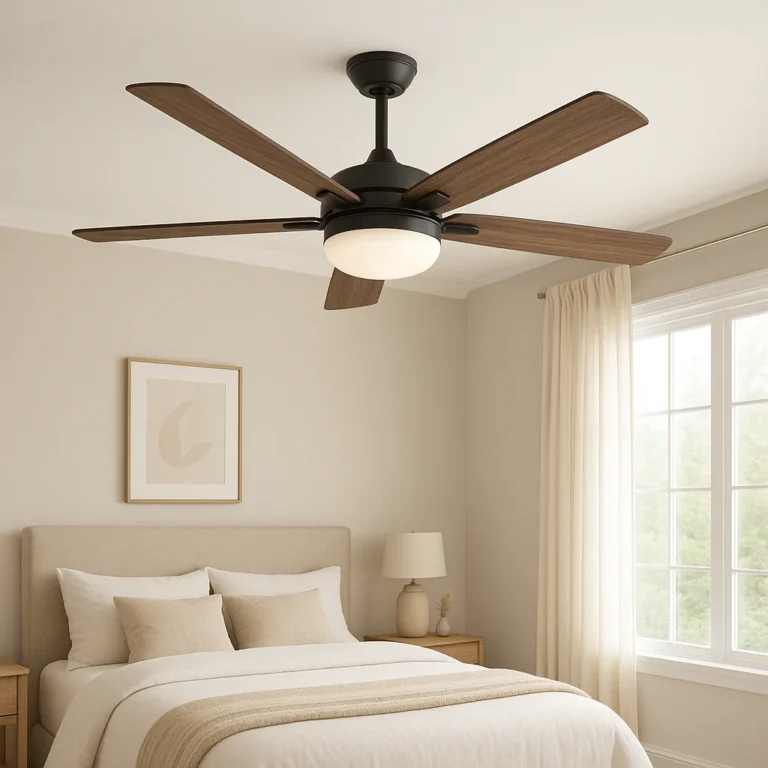
The quietest ceiling fan is usually a well-balanced model with smooth low-speed control, a secure fan-rated mount, and the right size for your room. Brushless DC fans are a strong place to start, but motor type alone can’t promise silence: blade airflow, controls, and installation all shape what you hear.
We’ve reviewed bedroom-friendly options, smart fans, and powerful picks for larger rooms, including models from Big Ass Fans, Hunter, Modern Forms, Minka-Aire, and Smafan. One lesson from listening closely: a faint airflow hush is often normal; a repeating click or ceiling-dep thump is a clue worth investigating.
Key Takeaways
- Start with the whole fan, not just its motor. Balance, blade design, controls, and installation all affect noise.
- Consider a brushless DC fan for smooth speed control, but check the exact model and its control compatibility.
- Match fan size and airflow to the room so you can stay comfortable without running it harder than necessary.
- For bedrooms, prioritize a stable low speed and convenient controls; for large rooms, check airflow and mounting requirements carefully.
- A noisy fan may need troubleshooting, not replacement. Loose hardware, dirty blades, control mismatches, or woble can be the culprit.
- Compare quiet-fan options: Big Ass Fans Haiku, Hunter ceiling fans, Modern Forms ceiling fans, and Smafan DC motor ceiling fans.
Table of Contents
- ⚡️ Quick Tips and Facts: Quietest Ceiling Fans at a Glance
- 🔇 What Makes a Ceiling Fan Quiet?
- How Ceiling Fan Noise Is Measured
- Why Some Fans Hum, Click, or Rattle
- 📜 A Brief History of Quiet Ceiling Fan Technology
- 🏆 12 Quietest Ceiling Fans Worth Considering
- 1. Best Overall Quiet Ceiling Fan
- 2. Best Quiet DC Motor Ceiling Fan
- 3. Best Quiet Ceiling Fan for Bedrooms
- 4. Best Quiet Ceiling Fan with a Light
- 5. Best Quiet Ceiling Fan for Large Rooms
- 6. Best Quiet Ceiling Fan for Small Rooms
- 7. Best Quiet Ceiling Fan for Low Ceilings
- 8. Best Quiet Ceiling Fan for High or Sloped Ceilings
- 9. Best Quiet Outdoor Ceiling Fan
- 10. Best Quiet Smart Ceiling Fan
- 11. Best Quiet Budget-Friendly Ceiling Fan
- 12. Best Quiet Ceiling Fan for Modern Interiors
- ⚙️ Ceiling Fan Motor Types: DC, AC, and Brushless
- Are DC Motor Ceiling Fans Quieter?
- Brushless Motors, Efficiency, and Speed Control
- 🌀 Blade Design, Balance, and Airflow
- Blade Count, Pitch, Shape, and Materials
- Airflow Ratings: CFM and Airflow Efficiency
- Why a Wobling Fan Gets Noisy
- 📐 Choose the Right Quiet Fan for Your Room
- Ceiling Fan Size by Room Dimensions
- Bedroom, Nursery, Living Room, and Home Office Fans
- Quiet Fans for Open-Plan Rooms
- Indoor, Damp-Rated, and Wet-Rated Fans
- 🎨 Quiet Ceiling Fan Styles, Finishes, and Lighting
- Modern, Traditional, and Minimalist Fan Designs
- Choosing Blade and Housing Materials
- Integrated Lights, Dimmers, and Color Temperature
- 📲 Controls and Smart Features
- Remote Controls, Wall Controls, and Pull Chains
- Smart Home Compatibility and Voice Control
- Reversible Direction and Seasonal Settings
- 🛠️ Installation Tips for a Quieter Ceiling Fan
- Choosing a Downrod and Mounting Style
- Electrical Boxes, Wiring, and Safety
- When to Hire a Licensed Electrician
- 🔧 How to Fix a Noisy Ceiling Fan
- Troubleshooting Humming and Buzzing
- Stopping Clicking, Scraping, and Rattling
- Balancing Wobling Fan Blades
- When Noise Signals a Motor or Electrical Problem
- 🧹 Maintenance for Long-Lasting Quiet Performance
- Cleaning Blades and Tightening Hardware
- Do Ceiling Fan Motors Need Lubrication?
- Replacement Parts, Warranty, and Expected Lifespan
- 🛒 How to Choose the Quietest Ceiling Fan for You
- Quietness, Airflow, Energy Use, and Budget
- Questions to Ask Before Buying
- Common Quiet Ceiling Fan Buying Mistakes
- ❓ Quietest Ceiling Fan FAQs
- What type of ceiling fan is the quietest?
- Are DC ceiling fans quieter than AC fans?
- Why does my ceiling fan make noise at low speed?
- Can a ceiling fan be completely silent?
- How do I stop my ceiling fan from wobling?
- Is a larger ceiling fan quieter?
- ✅ Conclusion
- 🔗 Recommended Links
- 📚 Reference Links
Table of Contents
- ⚡️ Quick Tips and Facts: Quietest Ceiling Fans at a Glance
- 🔇 What Makes a Ceiling Fan Quiet?
- How Ceiling Fan Noise Is Measured
- Why Some Fans Hum, Click, or Rattle
- 📜 A Brief History of Quiet Ceiling Fan Technology
- 🏆 12 Quietest Ceiling Fans Worth Considering
- 1. Best Overall Quiet Ceiling Fan
- 2. Best Quiet DC Motor Ceiling Fan
- 3. Best Quiet Ceiling Fan for Bedrooms
- 4. Best Quiet Ceiling Fan with a Light
- 5. Best Quiet Ceiling Fan for Large Rooms
- 6. Best Quiet Ceiling Fan for Small Rooms
- 7. Best Quiet Ceiling Fan for Low Ceilings
- 8. Best Quiet Ceiling Fan for High or Sloped Ceilings
- 9. Best Quiet Outdoor Ceiling Fan
- 10. Best Quiet Smart Ceiling Fan
- 11. Best Quiet Budget-Friendly Ceiling Fan
- 12. Best Quiet Ceiling Fan for Modern Interiors
- ⚙️ Ceiling Fan Motor Types: DC, AC, and Brushless
- Are DC Motor Ceiling Fans Quieter?
- Brushless Motors, Efficiency, and Speed Control
- 🌀 Blade Design, Balance, and Airflow
- Blade Count, Pitch, Shape, and Materials
- Airflow Ratings: CFM and Airflow Efficiency
- Why a Wobling Fan Gets Noisy
- 📐 Choose the Right Quiet Fan for Your Room
- Ceiling Fan Size by Room Dimensions
- Bedroom, Nursery, Living Room, and Home Office Fans
- Quiet Fans for Open-Plan Rooms
- Indoor, Damp-Rated, and Wet-Rated Fans
- 🎨 Quiet Ceiling Fan Styles, Finishes, and Lighting
- Modern, Traditional, and Minimalist Fan Designs
- Choosing Blade and Housing Materials
- Integrated Lights, Dimmers, and Color Temperature
- 📲 Controls and Smart Features
- Remote Controls, Wall Controls, and Pull Chains
- Smart Home Compatibility and Voice Control
- Reversible Direction and Seasonal Settings
- 🛠️ Installation Tips for a Quieter Ceiling Fan
- Choosing a Downrod and Mounting Style
- Electrical Boxes, Wiring, and Safety
- When to Hire a Licensed Electrician
- 🔧 How to Fix a Noisy Ceiling Fan
- Troubleshooting Humming and Buzzing
- Stopping Clicking, Scraping, and Rattling
- Balancing Wobling Fan Blades
- When Noise Signals a Motor or Electrical Problem
- 🧹 Maintenance for Long-Lasting Quiet Performance
- Cleaning Blades and Tightening Hardware
- Do Ceiling Fan Motors Need Lubrication?
- Replacement Parts, Warranty, and Expected Lifespan
- 🛒 How to Choose the Quietest Ceiling Fan for You
- Quietness, Airflow, Energy Use, and Budget
- Questions to Ask Before Buying
- Common Quiet Ceiling Fan Buying Mistakes
- ❓ Quietest Ceiling Fan FAQs
- ✅ Conclusion
- 🔗 Recommended Links
- 📚 Reference Links
⚡️ Quick Tips and Facts: Quietest Ceiling Fans at a Glance
For a room-specific shortlist, start with our guide to 🤫 7 Quietest Ceiling Fans for Living Room (2026). We review fans with a simple audio-enginering question in mind: does the sound fade into the room, or keep tapping you on the shoulder?
The short version
| What to check | Best quiet-fan clue | Why it matters |
|---|---|---|
| Motor | Brushless DC motor, well-reviewed AC motor, or both | Motor quality and speed control can reduce hum and mechanical noise |
| Stability | Rigid mounting and accurately balanced blades | Woble can create rhythmic noise and transfer vibration to the ceiling |
| Speed | Enough settings to find a genuinely low, steady speed | More control makes it easier to get comfortable airflow without running the fan flat out |
| Size | Fan diameter matched to the room | An appropriately sized fan can often move air at a gentler speed |
| Installation | Fan-rated electrical box, tight hardware, correct mounting | A good fan can still sound bad if its mounting is loose |
| Reviews | Comments describing the noise at specific speeds | “Quiet” is subjective; useful reviews say what the owner actually hears |
Our practical rule: shop for the combination of a stable mount, good motor, appropriate airflow, and a size that suits the room. A DC label is a promising clue, not a magic silencer.
Fast facts
- The U.S. Department of Energy’s Energy Saver guide describes fans as a way to create a cooling effect; they do not cool a room simply by lowering its air temperature.
- Fan noise is not just motor noise. Air rushing over blades, loose hardware, an unbalanced blade, a dimer mismatch, and ceiling vibration can all contribute.
- The ENERGY STAR ceiling fan guidance emphasizes choosing an efficient fan and considering airflow performance, not just appearance.
- A fan described as “near silent” by a brand or reviewer is not guaranteed to be inaudible in every home. Room acoustics, installation, fan speed, and your own hearing all matter.
- For a fan that will live in a bedroom, assess it at the speed you will actually use at night, not only at its lowest setting in a showroom.
A quiet fan should feel like a soft breeze, not a tiny helicopter auditioning for a ceiling role. So what separates a genuinely quiet model from a merely attractive one? Start with how its sound is made.
🔇 What Makes a Ceiling Fan Quiet?
The most helpful way to assess ceiling-fan noise is to separate it into motor noise, airflow noise, mechanical noise, and vibration. A fan can have an excellent motor and still click because a blade screw is loose. It can have perfect hardware and still sound prominent if it’s undersized and running at high speed.
| Noise source | What you may hear | Likely contributors |
|---|---|---|
| Motor | Hum, whine, buzz | Motor design, speed controller, electrical compatibility, wear |
| Airflow | Broad rushing or whoshing | Fan speed, blade geometry, room conditions |
| Mechanical | Clicking, ticking, scraping | Loose screws, wire contact, canopy or light kit parts |
| Vibration | Rhythmic thump, woble, ceiling resonance | Blade imbalance, loose mounting, unsuitable ceiling box |
A useful distinction: “quiet” does not necessarily mean “silent.” Air moving through a room makes some sound, and a fan’s audible profile changes as speed rises. We recommend listening for an even, smooth sound without strong hums, repeated clicks, or a woble that makes the noise surge and fade.
How Ceiling Fan Noise Is Measured
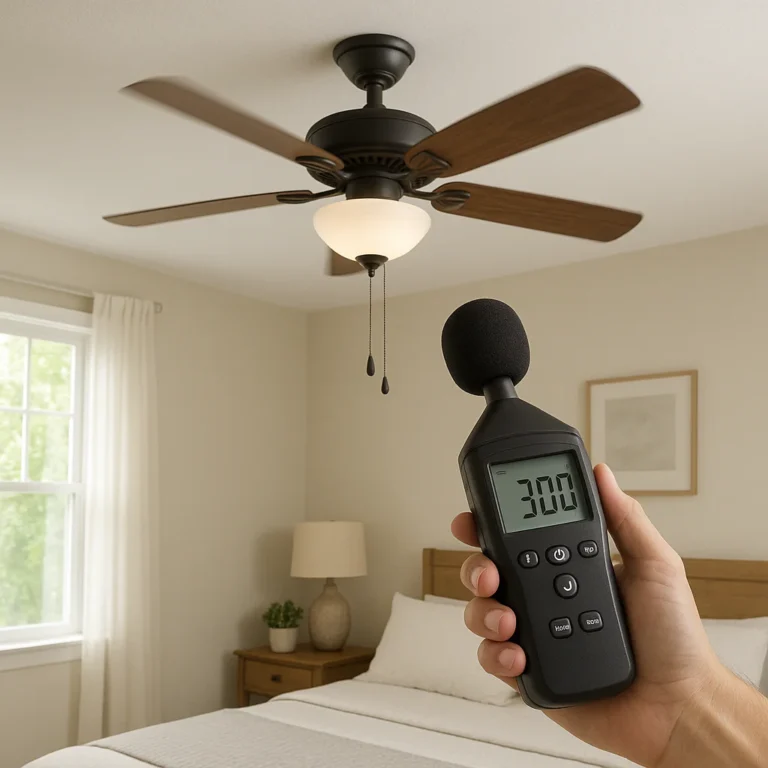
Sound-pressure level is often expressed in decibels (dB), but ceiling-fan brands do not always publish comparable, independently tested noise data. Even when a figure appears, the distance, room, background noise, fan speed, and measurement method can change the result. The National Institute for Occupational Safety and Health (NIOSH) explains the decibel scale; it is logarithmic, so small numerical changes do not translate into simple, linear changes in perceived loudness.
For consumer comparisons, use this order:
- Look for a defined test method. A dB figure without measurement distance or speed is hard to compare.
- Check reviews for specific symptoms. “No motor hum on low” is more informative than “quiet.”
- Listen at the intended setting. A fan can be whisper-soft at low speed but noticeably whosh at high speed.
- Separate the sound types. A smooth airflow sound may be normal; a new ticking or scraping noise deserves investigation.
We treat unverified “whisper-quiet” language as a manufacturer or reviewer impression, not a universal measured fact.
Why Some Fans Hum, Click, or Rattle
- Hum or buzz: May come from motor design, control compatibility, a loose canopy, or a failing electrical component.
- Click or tick: Often points to a loose blade screw, a wire touching a rotating part, or a light-kit component.
- Rattle: Check the canopy, pull-chain hardware, glass shades, and mounting hardware.
- Thumping or pulsing: May indicate blade imbalance, a loose fan-rated box, or vibration transferred into the ceiling.
- Scraping: Turn the fan off immediately and check for contact between a blade, housing, or wire. Do not run a fan that is visibly rubbing.
In our reviews, the distinction that saves the most needless shopping is this: a noisy fan is not automatically a bad fan. Sometimes the motor is fine and one small part is simply loose. We’ll return to that when we cover troubleshooting.
📜 A Brief History of Quiet Ceiling Fan Technology

Ceiling fans have evolved from mechanically simple air movers into products with electronic speed control, brushless motors, LED lighting, remote controls, and app-based automation. The details vary by model, but the broader change is clear: modern designs can offer finer speed control and more efficient operation than many older fixed-step fans.
| Design era or feature | What changed | Why quietness may improve |
|---|---|---|
| Traditional AC motor fans | Widely available, often simple controls | Quality varies; some models can produce audible electrical or mechanical hum |
| Electronic controls | More speed choices on some models | Lets you select a lower, more comfortable operating point |
| DC motor fans | Electronic conversion and motor control | Often lighter and more energy-efficient; many offer finer speed adjustment |
| Brushless DC designs | No motor brushes rubbing against a commutator | Removes one potential source of friction and wear |
| Smart controls | Scheduling, automation, and temperature response | Can reduce unnecessary high-speed operation |
The marketing story can get ahead of the engineering. A particular DC fan may be quieter than a particular AC fan, but motor category alone cannot predict the whole fan’s sound. Blade balance, housing, mounting, control electronics, and installation all matter. That is why we compare the complete fan, not just the letters on its product page.
🏆 12 Quietest Ceiling Fans Worth Considering
The models below are shortlist candidates, not a laboratory-certified ranking by decibel level. Brands do not provide one consistent independent noise test across all models, so weigh motor design, controls, intended use, reputable owner feedback, and fit for the room. Confirm the current model specification and installation requirements before buying.
Rating snapshot
| Fan or family | Design | Functionality | Quiet-use potential | Best fit | Main caveat |
|---|---|---|---|---|---|
| Big Ass Fans Haiku | 9 | 9 | 9 | Bedrooms and refined interiors | Verify configuration, controls, and compatibility |
| Big Ass Fans Haiku L | 8 | 8 | 8 | Bedrooms and guest rooms | Features differ from Haiku |
| Big Ass Fans i6 | 9 | 8 | 8 | Large modern spaces | Check room size and mounting needs |
| Hunter Aerodyne | 8 | 8 | 7 | Contemporary rooms | Confirm the exact motor and control setup |
| Hunter Dempsey | 8 | 8 | 7 | Bedrooms and living areas | Product specifications vary by version |
| Minka-Aire Light Wave | 9 | 8 | 7 | Modern rooms with integrated light | Review control and light-kit details |
| Modern Forms Wynd | 9 | 9 | 8 | Smart-home users | App and control features vary by model |
| Fanimation Odyn | 9 | 8 | 7 | Large rooms | Requires adequate clearance and correct sizing |
| Fanimation Kute | 8 | 8 | 7 | Smaller contemporary spaces | Verify exact blade span and light option |
| Smafan DC ceiling fans | 7 | 8 | 7 | Shoppers comparing DC styles | Check controller compatibility and ratings |
| Emerson ceiling fans | 8 | 7 | 7 | Classic and practical interiors | Availability and model range can vary |
| Casablanca ceiling fans | 9 | 8 | 7 | Premium traditional or transitional rooms | Match the chosen model to room and control needs |
How to read our ratings: a 9 for quiet-use potential means the design and available evidence make it a strong candidate when correctly installed; it does not mean a measured 9/10 sound test. Owner experiences vary with room and installation.
1. Best Overall Quiet Ceiling Fan
Big Ass Fans Haiku
The Haiku is a strong all-around candidate for buyers prioritizing a bedroom-friendly profile, precise control, and premium finish options. Big Ass Fans promotes its brushless DC motor, hand-balanced airfoils, and smart features; the specific features depend on the configuration. See the official Haiku product page for current specifications.
Why we’d shortlist it
- Brushless DC motor and multiple operating speeds.
- Blade and motor design intended to support stable operation.
- Optional smart features on applicable models.
- Choices suited to more than one interior style.
Trade-offs
- Premium smart functions may be unnecessary if you only want a basic fan.
- App, sensor, light, and control features vary across versions.
- A premium fan still needs careful mounting and correct sizing.
The manufacturer’s bedroom article calls the Haiku “the quietest bedroom ceiling fan you can buy.” That is the brand’s editorial claim, not an independent comparative lab finding. We consider the design promising, while advising buyers to judge the exact model and installed performance. Read the Haiku bedroom recommendations.
2. Best Quiet DC Motor Ceiling Fan
Smafan DC models
Smafan’s DC motor ceiling fan collection is useful for comparing brushless DC models across modern, farmhouse, industrial, and other styles. The brand says its DC fans offer fine speed control and efficient operation. As with any collection page, check each model’s room guidance, airflow, control type, and damp or wet rating rather than assuming every listed fan shares the same specs.
Potential advantages
- Brushless DC designs can avoid brush friction.
- More speed steps may make it easier to find a comfortable low setting.
- Several models include lighting and remote or smart controls.
Potential drawbacks
- DC fans require compatible controls. Smafan warns that its DC models are not suitable for standard fan-speed switches or dimers; use the specified controller.
- Features and outdoor ratings differ by model.
- A quiet motor cannot compensate for a loose box or unbalanced blades.
3. Best Quiet Ceiling Fan for Bedrooms
Big Ass Fans Haiku and Haiku L
For a bedroom, the most useful features are steady low-speed airflow, reliable controls, and the ability to switch the fan off or adjust it without a noisy chain pull. The Haiku and Haiku L families are worth considering. Big Ass Fans describes the Haiku as suitable for standard bedrooms up to 225 square feet and recommends larger models for bigger rooms; verify those room recommendations against the current model documentation.
The manufacturer’s article also notes that its SenseMe feature can adjust operation in response to room conditions. That can be convenient, but automation is not essential: a stable fan with a quiet remote can serve just as well if you prefer fewer connected devices.
Bedroom checklist
- Choose a fan span suitable for the room.
- Check for a genuinely low, stable speed—not merely many speed buttons.
- Consider a remote or wall control so you don’t need to pull a chain.
- If installing above a bed, make sure the fan is securely mounted and appropriately cleared from the ceiling and walls.
4. Best Quiet Ceiling Fan with a Light
Hunter Dempsey or a compatible integrated-light model
A fan-light combination reduces clutter, but it adds parts that can introduce rattles or electrical hum if the light kit, shades, or controls are loose or incompatible. The Hunter Dempsey family is a candidate for buyers who want a streamlined bedroom or living-room fixture; compare the exact product’s motor, light, control, and ceiling-mount specifications.
Look for
- A light assembly that is firmly secured.
- Dimming support that matches the included LED driver and controller.
- Replaceable components or clearly documented service parts.
- An integrated light only if it suits your preferred color temperature and brightness.
5. Best Quiet Ceiling Fan for Large Rooms
Big Ass Fans i6 or Haiku 60-inch models
Large rooms often benefit from a larger fan that can circulate air without being driven at top speed. Big Ass Fans lists i6 and larger Haiku options for more expansive spaces. Always compare the room’s dimensions, ceiling height, and airflow guidance with the exact model.
A big fan is not automatically a quiet fan. If it is oversized, poorly mounted, or too close to a wall or beam, it may produce unwanted airflow noise or vibration. Check the specified blade span and clearances before committing.
6. Best Quiet Ceiling Fan for Small Rooms
Big Ass Fans Haiku L 44-inch or a compact Fanimation model
A smaller room needs a fan that circulates air without overwhelming the space. The Haiku L is offered in smaller configurations, while Fanimation’s ceiling fan range includes models in different sizes. Confirm the actual diameter, minimum ceiling height, and room recommendation for the selected model.
Small-room priorities
- Suitable blade span rather than the smallest available fan by default.
- Low-speed control for sleep or desk work.
- A compact light kit if headroom is limited.
- Clearance from bunk beds, upper cabinets, doors, and nearby walls.
7. Best Quiet Ceiling Fan for Low Ceilings
Flush-mount or low-profile models
Low ceilings call for a flush-mount or low-profile design, but don’t choose purely by how close the motor sits to the ceiling. The blades still need safe clearance, and the fan must be attached to a correctly rated electrical box. Hunter’s ceiling fan buying guide explains mounting options and sizing considerations.
Before buying
- Measure floor-to-ceiling height.
- Check the manufacturer’s total installed height and blade clearance.
- Verify whether the fan is truly flush mount or uses a short downrod.
- Confirm that the electrical box is listed for fan support.
8. Best Quiet Ceiling Fan for High or Sloped Ceilings
Downrod-mounted fans with slope-compatible hardware
For a high ceiling, a downrod can position the blades where they circulate air effectively. Sloped ceilings may require an approved angled-ceiling adapter. The right setup improves airflow and can help avoid a fan running unnecessarily fast—but use only the mounting arrangement approved for that model.
Check the manual for:
- Maximum and minimum downrod lengths.
- Slope angle limits.
- Required canopy or adapter.
- Clearance from beams, walls, and light fixtures.
If the ceiling angle or wiring is unusual, ask a qualified installer rather than improvising with a universal-looking part.
9. Best Quiet Outdoor Ceiling Fan
Damp- or wet-rated fan selected for the location
Outdoor conditions demand the correct safety rating. A damp-rated fan is typically intended for covered, protected locations; a wet-rated fan is designed for direct exposure to weather, subject to the manufacturer’s instructions. UL explains safety certification and product marks through its consumer safety resources.
Consider Modern Forms outdoor ceiling fans or another established brand’s model, but check the specific product listing. Outdoor wind, humidity, and nearby hard surfaces can make airflow sound more noticeable than it is indoors.
10. Best Quiet Smart Ceiling Fan
Modern Forms Wynd or compatible Big Ass Fans Haiku
Smart controls can schedule a fan, change speed from an app, and integrate with some voice assistants. The Modern Forms Wynd and selected Haiku models are worth comparing.
Smart-fan advantages
- Adjust speed without reaching a wall switch.
- Build schedules for bedtime or occupancy.
- Integrate with compatible smart-home systems.
Possible annoyances
- App support and smart-home compatibility can vary by generation.
- A fan that loses Wi-Fi should still have a reliable local control method.
- Automation should not be confused with sound reduction: the motor, blades, mounting, and speed still determine what you hear.
11. Best Quiet Budget-Friendly Ceiling Fan
A well-reviewed Hunter or Emerson AC model
A reliable AC fan can be quiet in everyday use when it is properly installed, balanced, and controlled with compatible hardware. Compare Hunter’s current ceiling fan range with Emerson’s ceiling fan offerings. We avoid naming a universal “best value” model because availability and specifications change, and one family can contain several different motors and controls.
Value-shopping tips
- Prioritize fan-rated mounting and a clear installation manual.
- Look for owner reviews that mention hum and woble after months of use.
- Check replacement-part access, warranty terms, and included controls.
- Skip decorative extras that do not solve a real room need.
12. Best Quiet Ceiling Fan for Modern Interiors
Minka-Aire Light Wave or Modern Forms designs
For a contemporary look, compare Minka-Aire and Modern Forms models. Sculpted blades and integrated LED lights can look elegant, but quieter operation still depends on the whole installation.
Design note: a dramatic finish is a style decision; blade balance and secure hardware are sound decisions. Happily, you can have both.
⚙️ Ceiling Fan Motor Types: DC, AC, and Brushless
The motor is a major part of a fan’s sound, but it is only one part. Both AC and DC fans can be quiet—or frustratingly noisy—depending on build quality, controls, wear, and installation.
| Motor type | Typical control | Potential strengths | Things to check |
|---|---|---|---|
| AC | Often wall control, pull chain, or compatible remote | Broad availability; familiar installation | Hum at some speeds; controller compatibility |
| DC | Electronic controller, often remote or dedicated wall control | Fine speed adjustment; efficient operation on many models | Requires model-specific controls; verify replacement remotes |
| Brushless DC | Electronic commutation without motor brushes | Avoids brush-related friction and wear | Still depends on bearings, balance, electronics, and mounting |
Are DC Motor Ceiling Fans Quieter?
Often, but not by definition. A quality DC fan may deliver smooth low-speed operation and more speed choices than a basic AC model. Smafan describes brushless DC models as quieter than AC fans and cites energy savings of up to 75% for its comparison; that figure is a brand claim, not a guaranteed result for every fan, operating pattern, or household. See the Smafan DC fan collection.
A competing bedroom guide calls the Haiku “near-silent,” while Smafan says a brushless DC ceiling fan is “usually the quietest choice.” These are helpful product perspectives, not controlled head-to-head sound tests. The sensible resolution is to treat DC as a useful shortlist signal, then verify the actual model, speed, installation, and owner experience.
Brushless Motors, Efficiency, and Speed Control
A brushless DC motor uses electronic control rather than brushes rubbing against a commutator. That removes one possible source of friction, but it does not remove airflow noise, bearing noise, poor balance, or loose parts.
When comparing DC models:
- Check how many usable speeds are offered.
- Confirm whether the included remote or wall control is required.
- Read the manual before pairing a third-party dimer or fan control.
- Look for warranty details covering the motor and electronics separately.
Some DC fans are not compatible with standard fan-speed switches or light dimers. Smafan specifically advises using compatible dedicated controls for its DC models. Always follow the model’s installation manual.
🌀 Blade Design, Balance, and Airflow
Blades affect how much air moves, how smoothly it moves, and how much aerodynamic sound you hear. A quiet fan needs more than an attractive blade profile: the blades must be matched, balanced, undamaged, and correctly installed.
Blade Count, Pitch, Shape, and Materials
There is no universal rule that five blades are quieter than three. Blade count interacts with motor speed, blade area, pitch, shape, and the fan’s control system. The Department of Energy’s fan guidance explains how fans create a cooling effect through air movement; for model-to-model comparisons, use published airflow data alongside the manufacturer’s operating instructions.
| Blade feature | What it affects | What to consider |
|---|---|---|
| Count | Design, resistance, and overall airflow characteristics | Count alone does not predict quietness |
| Pitch | How aggressively a blade moves air | More air movement may require more motor effort |
| Shape | Airflow distribution and aerodynamic sound | Compare the fan as a complete system |
| Material | Weight, stiffness, and durability | Inspect for warping, damage, and secure attachment |
| Balance | Smoothness of rotation | Uneven blades can cause vibration and rhythmic sound |
Airflow Ratings: CFM and Airflow Efficiency
CFM means cubic feet per minute, a measure of airflow. A high CFM rating may indicate strong air movement, but it does not tell you whether the fan will sound quiet in your particular room. Compare airflow with fan size and energy use; ENERGY STAR’s ceiling-fan resources offer a useful starting point for efficient models.
A quiet-use approach: choose an appropriately sized fan with enough airflow for the room, then run it at the lowest comfortable setting. Don’t assume the fan with the largest CFM number is the best bedroom choice.
Why a Wobling Fan Gets Noisy
Woble can create a repeating thump or vibration that travels through the ceiling. The causes include:
- Uneven blade weight or alignment.
- Loose blade screws or brackets.
- A mounting box that is not suitable for fan support.
- A bent bracket, damaged blade, or improperly seated downrod.
A small amount of movement may be visible on some installations, but pronounced or worsening woble is not something to ignore. Turn the fan off and inspect it safely from a stable ladder, or call an installer if the mounting is in question.
📐 Choose the Right Quiet Fan for Your Room
A well-matched fan can move air effectively at a lower speed, reducing the sense of rushing noise. The right size depends on room area, shape, ceiling height, furniture, and the fan’s own airflow characteristics.
Ceiling Fan Size by Room Dimensions
Use the sizing guidance from the specific manufacturer rather than treating any chart as a building code. Hunter’s ceiling fan buying guide provides practical room and mounting considerations.
| Room size | General shopping approach | Check before purchase |
|---|---|---|
| Small bedroom or office | Compact fan sized for the room | Low-speed setting, clearance, light kit |
| Standard bedroom | Mid-size fan matched to floor area | Airflow, noise reviews, mount height |
| Large bedroom or living room | Larger fan or multiple fans if appropriate | Ceiling height, downrod, room layout |
| Open-plan area | Fan sized for the zone it serves | Airflow reach, obstructions, control access |
These are broad categories, not a substitute for the manufacturer’s sizing recommendations. A long, narrow room may need a different solution from a square room with the same floor area.
Bedroom, Nursery, Living Room, and Home Office Fans
Bedroom: prioritize smooth low-speed operation, an easy-to-use remote, and a stable mount.
Nursery: choose a securely installed model with controls adults can operate easily. Follow local electrical and building requirements, and keep cords or pull chains out of reach.
Living room: consider airflow coverage, lighting needs, and whether conversation or TV audio sits directly beneath the fan. Our living-room fan guide focuses on models for shared spaces.
Home office: look for gentle airflow that does not disturb papers or create a constant sound competing with calls. If you already manage room noise, our noise-reduction tips may help with the rest of the space too.
Quiet Fans for Open-Plan Rooms
Open-plan rooms have fewer boundaries to absorb or contain sound, and a fan’s airflow may be more noticeable across a broad space. Consider:
- Matching the fan to the seating or working zone.
- Using a larger fan at a lower setting where appropriate.
- Avoiding placement too close to tall cabinets or beams.
- Comparing one properly sized fan with multiple smaller fans based on the layout.
A single giant fan can look compelling, but the room’s geometry gets the final vote.
Indoor, Damp-Rated, and Wet-Rated Fans
Choose the rating that matches the location:
- Indoor: intended for normal interior spaces.
- Damp-rated: suitable for some protected, humid locations, subject to its listing.
- Wet-rated: designed for exposure to moisture or weather within the manufacturer’s limits.
Do not infer the rating from a fan’s appearance or the word “outdoor” in a retailer title. Confirm it in the product manual or official specifications. Certification and installation requirements matter more than a splashy finish.
🎨 Quiet Ceiling Fan Styles, Finishes, and Lighting
Looks matter: a fan is a large moving object in the middle of your ceiling. The trick is choosing a style without allowing decorative details to distract from motor, airflow, mounting, and controls.
Modern, Traditional, and Minimalist Fan Designs
- Modern: clean profiles and integrated lighting; compare smart controls and serviceability.
- Traditional: familiar silhouettes, often with multiple finish and blade options.
- Minimalist: understated housings and fewer visual details; check that remote or wall controls are included.
- Industrial or farmhouse: distinctive materials and shapes; make sure the blades and housing suit the room’s scale.
Browse Quietest’s low-noise household guides for more home-equipment advice, but judge a fan by its own specs and installation needs.
Choosing Blade and Housing Materials
Wood, metal, composite, and molded plastic blades each have design and durability trade-offs. Material alone does not determine fan noise. What matters acoustically is how the complete blade assembly behaves at operating speed—and whether it stays balanced over time.
Before installation, inspect every blade for:
- Visible cracks, chips, or warping.
- Identical mounting alignment.
- Secure screws and brackets.
- Clearance from light fixtures, beams, and walls.
Integrated Lights, Dimmers, and Color Temperature
An integrated LED can simplify the fixture, but the driver and control system must be compatible with diming. A light that flickers or buzzes can make you blame the fan motor unfairly.
Check:
- Whether the light is dimable.
- Which wall control or remote supports diming.
- Color-temperature options and brightness.
- Whether the LED module is replaceable or serviceable.
Do not connect a fan-light combination to a generic dimer unless the manufacturer specifically permits it. The wrong control can create buzzing, flicker, or electrical issues.
📲 Controls and Smart Features
Controls affect everyday usability and can influence noise indirectly: a convenient low-speed setting makes it easier to avoid running the fan harder than needed. But controls must be compatible with the motor.
Remote Controls, Wall Controls, and Pull Chains
A remote is handy for a bed or sofa. A wall control is convenient for daily use. Pull chains are simple, but they may click against a housing or become awkward in high-ceiling rooms.
Before buying, find out:
- What control is included.
- Whether it controls both the fan and light.
- Whether a wall control replaces or supplements the remote.
- How to obtain a replacement if the remote is lost.
Smart Home Compatibility and Voice Control
Smart fans may integrate with systems such as Amazon Alexa, Google Assistant, Apple HomeKit, or app-specific platforms. Compatibility is model- and generation-specific, so verify the current manufacturer listing before purchase.
Smart features are most useful when they solve a real problem: bedtime schedules, easy speed changes, or temperature-based adjustments. They are less useful if setup is fiddly and you end up using the physical switch anyway.
Reversible Direction and Seasonal Settings
Many fans can reverse direction to change how air circulates. The correct direction and speed depend on the room, season, and manufacturer instructions. Reversal is not a noise fix; if the fan hums or wobbles, address that underlying issue first.
🛠️ Installation Tips for a Quieter Ceiling Fan
The quietest motor in the catalog can still sound rough if mounted incorrectly. Installation is not a footnote; it is part of the acoustic system.
Choosing a Downrod and Mounting Style
Use the mount type and downrod length specified for the fan and ceiling. A flush mount can help in rooms with limited height; a downrod may suit taller or sloped ceilings. Follow the manufacturer’s clearances and ensure blades are safely positioned above the floor.
The National Electrical Code and local rules may apply. For general installation and electrical safety information, consult the U.S. Consumer Product Safety Commission and your local authority; for product-specific steps, use the supplied manual.
Electrical Boxes, Wiring, and Safety
A ceiling fan must be attached to a box and support structure rated for fan use. A standard light-fixture box may not be suitable. The Electrical Safety Foundation International (ESFI) provides residential electrical safety guidance.
Safe-installation basics
- Turn power off at the breaker, not only at the wall switch.
- Verify the circuit is de-energized with an appropriate tester.
- Follow the model’s wiring diagram exactly.
- Use the specified fan-rated box and mounting hardware.
- Do not force incompatible wall controls or dimers.
When to Hire a Licensed Electrician
Call a qualified electrician if wiring is damaged, the box is loose, the ceiling is sloped or unusually high, the existing support is unknown, or you are uncertain about the circuit or control compatibility. A securely supported fan is quieter and safer than one hanging from an inadequate fixture box.
🔧 How to Fix a Noisy Ceiling Fan
Before diagnosing anything, turn the fan off and let it stop completely. If you need to inspect blades or hardware, switch off power at the breaker. Never reach into a moving fan, and stop using it if it scrapes, smells hot, sparks, or shakes severely.
Troubleshooting Humming and Buzzing
- Identify when the sound occurs. Does it happen at every speed or only one?
- Check control compatibility. A mismatched dimer or wall control can create buzz.
- Inspect the canopy and light assembly. Loose components can resonate.
- Test the fan using its supplied control. If the noise changes, the control may be involved.
- Contact the manufacturer or electrician if the sound persists, grows louder, or seems electrical.
A faint steady sound may be normal for some fans, but a new or pronounced buzz is not something we’d dismiss as “just how ceiling fans are.”
Stopping Clicking, Scraping, and Rattling
With power off:
- Tighten accessible blade and light-kit screws according to the manual.
- Check that glass shades, pull chains, and decorative covers are secure.
- Look for wire contact with the housing, without pulling or damaging wiring.
- Inspect blades for damage or obstruction.
- Confirm the canopy is seated correctly.
If scraping continues or you find damaged wiring, stop and contact a qualified professional.
Balancing Wobling Fan Blades
Use the manufacturer’s balancing kit if supplied. A typical process is:
- Switch off power and inspect all blade screws.
- Ensure blades and brackets are installed in the correct positions.
- Run the fan at a moderate speed and identify whether woble repeats.
- Move the balancing clip between blade positions according to the kit instructions.
- Add the included weight where the instructions indicate.
- Re-test before making another adjustment.
Do not add improvised weights, tape, or hardware. If woble is severe or the mounting itself moves, turn the fan off and have the installation checked.
When Noise Signals a Motor or Electrical Problem
Get professional help if the fan has a burning smell, sparks, a hot housing, damaged insulation, sudden speed changes, severe vibration, or persistent electrical buzzing. Those are not “sleep ambience.” Disconnect power if it is safe to do so and arrange inspection.
🧹 Maintenance for Long-Lasting Quiet Performance
A light maintenance routine can prevent dust, loosened hardware, and imbalance from turning a comfortable fan into a ceiling percussion section.
Cleaning Blades and Tightening Hardware
- Dust blades regularly with a stable ladder and a suitable cloth.
- Clean both sides of each blade so dust does not collect unevenly.
- Check accessible screws periodically, following the manual.
- Avoid bending blades or applying cleaning products that could damage their finish.
- Stop if you see cracks, warping, or loose structural parts.
The U.S. Department of Energy’s home energy resources offer broader efficiency advice; for care instructions, the fan manual is the authority.
Do Ceiling Fan Motors Need Lubrication?
Many modern ceiling fans use sealed or permanently lubricated bearings and should not be oiled by the owner. Other designs may have different maintenance instructions. Don’t add oil unless the manufacturer’s manual explicitly calls for it; the wrong lubricant or method can damage the motor or attract dust.
Replacement Parts, Warranty, and Expected Lifespan
Warranty terms vary by model, manufacturer, and component. Check coverage for the motor, electronics, light kit, and accessories separately. Keep the receipt, model number, installation date, and manual.
If the fan becomes noisy after years of service, first inspect simple causes—dust, loose hardware, and blade damage. A persistent bearing or motor problem may justify repair or replacement, especially if parts are unavailable.
🛒 How to Choose the Quietest Ceiling Fan for You
The right choice is not simply the model with the quietest-sounding marketing copy. It is the fan that delivers the airflow you need at a tolerable sound level, with controls and installation you can live with.
Quietness, Airflow, Energy Use, and Budget
| Priority | What to compare | A sensible approach |
|---|---|---|
| Quiet operation | Owner reports, motor type, control, balance | Look for specific reports by speed and symptom |
| Airflow | CFM, size, room recommendation | Choose for the room, not the biggest number |
| Energy use | Motor type and published efficiency data | Compare verified specifications; usage patterns matter |
| Convenience | Remote, wall control, smart features | Buy only features you expect to use |
| Long-term ownership | Warranty, parts, manual, support | Check service information before purchase |
| Installation | Mount type, box support, wiring | Budget time and professional help where needed |
For a broader home-noise perspective, Quietest also covers quiet electronics, low-noise kitchen gadgets, and noise-free transportation. Different products, same principle: match the equipment to the environment instead of asking one spec to do all the work.
Questions to Ask Before Buying
- Is the motor AC, DC, or brushless DC?
- What does the manufacturer say about the specific room size?
- Is there a low, stable speed suitable for sleeping?
- Is the fan rated for the intended indoor or outdoor location?
- Which controls are included, and are they model-specific?
- Is the fan compatible with the electrical box and ceiling angle?
- Are replacement parts and warranty terms documented?
- Do reviews mention hum, clicking, or woble after installation?
Common Quiet Ceiling Fan Buying Mistakes
❌ Choosing only by blade count. Blade count alone does not establish quietness.
❌ Trusting “silent” as a measured specification. Look for test conditions or treat the wording as promotional.
❌ Ignoring controls. An incompatible dimer or fan-speed switch can cause noise or malfunction.
❌ Buying the wrong size. An undersized fan may need to run faster; an oversized fan may not suit the room or its clearances.
❌ Assuming a light box can support a fan. Confirm the box is fan-rated and securely attached.
❌ Overlooking owner-review details. Search within reviews for “hum,” “woble,” “click,” and “low speed”—the unglamorous words that often tell you the most.
❓ Quietest Ceiling Fan FAQs

What maintenance tips help keep a ceiling fan operating quietly?
Clean dust from both sides of the blades, check accessible screws and covers for looseness, and inspect blades for damage or warping. Follow the manufacturer’s manual for all maintenance. Do not lubricate a sealed motor unless the manual explicitly instructs you to do so.
A fan that develops a new sound deserves a quick inspection. Clicking and rattling often come from loose parts; persistent hum or vibration may need a technician.
Read more about “🤫 10 Quietest Bathroom Fans of 2026: Silent Steam Control”
How does blade design affect the noise level of a ceiling fan?
Blade shape, pitch, size, material, and balance affect airflow and aerodynamic sound. No single blade count guarantees quieter operation. Compare the complete fan’s airflow and owner feedback, and make sure the blades are undamaged and properly installed.
Read more about “Sofucor 52″ Noiseless Ceiling Fan: Quiet or Hype? 🌿”
Can a ceiling fan be both powerful and quiet?
Yes. A fan can move substantial air while remaining comfortable to listen to if it is correctly sized, well balanced, securely mounted, and operated at an appropriate speed. A larger fan running gently may suit some rooms better than a smaller fan pushed hard, but room geometry and model design still matter.
Read more about “How to Pick a Quiet Ceiling Fan: 15 Smart Checks 🤫”
What is the difference between DC and AC motor ceiling fans in terms of noise?
DC fans often offer finer speed control and can operate efficiently at lower speeds. Brushless DC motors avoid brush friction, which can remove one possible noise source. But a well-made AC fan can also be quiet, and a poorly installed DC fan can still woble, buzz, or rattle. Compare the exact model and its control requirements rather than choosing by motor label alone.
Are there specific brands known for producing quiet ceiling fans?
Big Ass Fans, Hunter, Modern Forms, Minka-Aire, Fanimation, Emerson, Casablanca, and Smafan all offer models worth comparing. Their product lines differ, and no brand makes every fan equally quiet. Look at the individual model’s motor, size, controls, warranty, and owner feedback.
Read more about “🤫 15 Quietest Ceiling Fans with Light (2026): Silence Unleashed”
How can I reduce noise from my existing ceiling fan?
Turn off power before inspection. Tighten accessible screws, check the light kit and canopy, clear any obstruction, clean the blades, and use the manufacturer’s balancing kit if the fan wobbles. Confirm the wall control is compatible. Stop using the fan and seek professional help if you notice scraping, a burning smell, sparks, severe shaking, or persistent electrical noise.
Read more about “🛁 12 Best Broan Bathroom Fans for Quiet, Dry Air (2026)”
Which ceiling fans are recommended for noise-sensitive rooms?
Consider fans with good low-speed control, stable blade assemblies, and reliable installation documentation. The Big Ass Fans Haiku and Haiku L, selected Modern Forms models, and suitable Smafan DC models are reasonable candidates to compare. The best option depends on room size, ceiling, control preference, and how sensitive you are to airflow sound.
Read more about “🌧️ Honeywell Dehumidifier Review: 7 Top Models Ranked (2026)”
What features make a ceiling fan the quietest option?
Look for:
- A quality motor and smooth speed control.
- Properly balanced blades and a stable mount.
- Correct sizing for the room.
- Compatible remote or wall controls.
- Clear installation and service instructions.
- Credible owner feedback describing operation at low and medium speeds.
“Whisper quiet” is not a substitute for those details.
Read more about “🤫 9 Quietest Fans: Your Guide to Silent Cooling (2026)”
Are there ceiling fans specifically designed for bedrooms or nurseries that are extra quiet?
Yes. Some product families are marketed for bedrooms and include brushless DC motors, low-speed settings, remote controls, or automation. Big Ass Fans’ Haiku bedroom guide discusses the Haiku range. For a nursery, also prioritize secure mounting, safe clearances, and controls that are easy for caregivers to use.
Read more about “7 Quiet Humidifiers for Low-Noise Comfort”
What is the average decibel level of a quiet ceiling fan?
There is no dependable universal average because brands do not consistently publish comparable dB measurements for the same speed, distance, and room conditions. A decibel figure is useful only when its measurement method is clear. For a practical comparison, listen at the intended operating speed and check for hum, clicking, and vibration.
Read more about “10 Quietest Window Air Conditioners (2026) 🤫”
How do I troubleshoot a noisy ceiling fan?
First identify whether the noise is hum, click, rattle, scrape, or rhythmic thump. Turn off the fan and power before inspecting it. Check screws, shades, canopy, blades, control compatibility, and visible damage. Use only the included balancing method. For electrical symptoms, severe woble, or scraping that continues, contact a qualified professional.
Read more about “🔇 11 Ways to Make a Ceiling Fan Quieter”
Can the installation process impact how quiet a ceiling fan is?
Absolutely. A fan attached to an unsuitable or loose electrical box can vibrate, woble, and transfer sound into the ceiling. Incorrect downrod setup, loose hardware, poor blade alignment, or an incompatible control can also create noise. Follow the fan’s manual, use a fan-rated box, and hire an electrician if the support or wiring is uncertain.
Read more about “Windmill Air Conditioner Review (2026): 7 Reasons It Beats July & More! ❄️”
Are quiet ceiling fans always DC motor fans?
No. DC and brushless DC fans are strong candidates for smooth, low-speed operation, but motor type alone does not settle the question. Blade design, balance, controls, installation, and manufacturing quality all influence sound. Treat DC as a useful filter—not a guarantee.
Why does my fan make noise only at one speed?
Some fans resonate at particular speeds, and certain control systems may produce hum at specific settings. Loose parts can also vibrate only within a narrow speed range. Check the controls and hardware; if the noise is electrical, new, or getting worse, stop using the fan until it has been assessed.
Read more about “60 Quietest Dehumidifiers Tested: 💤 Top Picks (2026)”