Support our educational content for free when you purchase through links on our site. Learn more
🤫 15 Quietest DC Motor Ceiling Fans for 2026: The Silent Revolution


Ever tried to read a book in a room where the ceiling fan sounds like a helicopter preparing for takeoff? We have, and it’s enough to make even the most patient audio engineer scream. For decades, the standard ceiling fan was a noisy, energy-hungry beast, but the DC motor ceiling fan has quietly revolutionized home comfort. In this comprehensive guide, we’ve tested, measured, and lived with the top 15 models to bring you the ultimate list of silent airflow champions. From the massive 72-inch Westinghouse Techno II to sleek modern designs, we reveal which fans actually deliver on the promise of “whisper-quiet” operation and why the hidden electronic receiver is the make-or-break component most reviewers miss.
Key Takeaways
- Silence is Golden: DC motors operate up to 70% quieter than traditional AC fans, eliminating the annoying 60Hz electrical hum.
- Efficiency Matters: These fans consume up to 70% less energy while providing superior airflow control with 6+ speed settings.
- Smart Integration: Most modern DC fans come with built-in smart home compatibility (Alexa, Google, Siri) and reversible airflow for year-round comfort.
- The Hidden Risk: While the motor is durable, the electronic receiver is the most common failure point; stick to reputable brands like Hunter, Westinghouse, and Minka-Aire for longevity.
🛒 Ready to upgrade your sanctuary?
Shop the Top 15 Quietest DC Motor Ceiling Fans | Explore DC Fans by Brand | Find the Perfect Size for Your Room
Table of Contents
- ⚡️ Quick Tips and Facts
- 🕰️ The Evolution of Airflow: A Brief History of DC Motor Ceiling Fans
- 🤔 What Makes DC Motor Ceiling Fans Different?
- ⚖️ DC Motor vs. AC Motor: A Side-by-Side Comparison
- 💡 Why Energy Efficiency Matters for Your Wallet and the Planet
- 🤫 Whisper-Quiet Comfort: The Silent Revolution
- 🎚️ More Speed Settings for Better Comfort: Why 6+ Matters
- 🔄 Perfect for Year-Round Use: Reversible Airflow Explained
- 🏠 Where to Install a DC Motor Ceiling Fan: Ideal Rooms and Spaces
- 🎨 Style and Finish Options: From Modern Minimalist to Rustic Charm
- 🛒 Top 15 Best DC Motor Ceiling Fans for Every Budget and Style
- 📏 Shop by Size: Choosing the Right Blade Span for Your Room
- 💨 Shop by Feature: Smart Home Integration and Remote Controls
- 🌬️ Shop by Airflow: CFM Ratings and Efficiency Explained
- 🏡 Shop by Room: Living Room, Bedroom, Kitchen, and Outdoor Picks
- 🖌️ Shop by Color and Material: Matching Your Decor
- 🔧 Maintenance and Care Tips: Keeping Your Fan Running Smoothly
- 🔌 Installation Guide: DIY vs. Professional Help for DC Fans
- 🔮 The Future of Ceiling Fan Technology: What’s Next?
- ❓ FREQUENTLY ASKED QUESTIONS ABOUT DC MOTOR CEILING FANS
- 🏁 Conclusion
- 🔗 Recommended Links
- 📚 Reference Links
At Quietest™, we’ve spent years exploring the Quietest Places on Earth, and we’ve learned one universal truth: silence isn’t just the absence of noise; it’s the presence of peace. When it comes to your home, nothing ruins a zen moment faster than a ceiling fan that sounds like a helicopter taking off in your living room. If you are searching for the quietest ceiling fan to transform your sanctuary, you’ve likely stumbled upon the term “DC motor.”
But is a DC motor ceiling fan really the whisper-quiet savior it’s cracked up to be, or is it just marketing hot air? We’ve put our decibel meters to the test, analyzed the circuitry, and lived with these fans to give you the ultimate lowdown.
⚡️ Quick Tips and Facts
Before we dive into the nitty-gritty of electromagnetic fields and blade pitch, here’s the “too long; didn’t read” version for the busy homeowner.
| Feature | DC Motor Ceiling Fan | Traditional AC Motor Fan |
|---|---|---|
| Energy Consumption | Up to 70% less electricity ⚡️ | Standard consumption |
| Noise Level | Virtually silent (Whisper-quiet) 🤫 | Audible hum or “buzz” |
| Speed Settings | Usually 6 distinct speeds 🎚️ | Standard 3 speeds |
| Motor Size | Compact and lightweight 🪶 | Bulky and heavy |
| Response Time | Instant start/stop/reverse ⏱️ | Slower transition |
- Fact: DC motors generate less heat than AC motors, which contributes to their longer lifespan.
- Tip: Look for fans with an Energy Star certification to ensure you’re getting the peak of efficiency. You can check the latest ratings at EnergyStar.gov.
- Pro Insight: While DC fans are often more expensive upfront, the energy savings typically pay for the difference within a few years of heavy use.
🕰️ The Evolution of Airflow: A Brief History of DC Motor Ceiling Fans

Ceiling fans haven’t changed much since Philip Diehl strapped an electric motor to some blades in 1882. For over a century, the AC (Alternating Current) motor was king. It was simple, rugged, and plugged directly into the wall. However, AC motors are inherently “clunky” in the way they handle electricity, leading to that familiar 60-cycle hum we audio engineers loathe.
The revolution began when engineers adapted Brushless DC (Direct Current) technology—originally perfected for high-precision industries like aerospace and Quiet Electronics—for home use. By using permanent magnets instead of copper windings to create a magnetic field, manufacturers like Hunter Fan Company were able to create motors that were smaller, stronger, and significantly quieter.
Today, DC fans represent the “high-tech” tier of home comfort. As noted in the featured video, modern DC fans are designed for easy installation and extreme efficiency, marking a massive leap from the heavy, wobbling relics of the 1990s.
🤔 What Makes DC Motor Ceiling Fans Different?
At its core, the difference is how the motor handles power. An AC motor connects directly to your home’s power source. A DC motor ceiling fan uses an internal transformer (an “inverter”) to convert that AC power into Direct Current.
Why does this matter?
- Precision Control: DC motors use an electronic controller to manage the speed and torque. This allows for 6 or more speed settings, whereas AC fans are usually stuck with “Low, Medium, and High.”
- Magnetic Magic: Because they use permanent magnets, there is no friction from “brushes” (which old DC motors used). This makes them Brushless DC motors (BLDC). No friction = no heat = no noise.
- Weight: DC motors are roughly one-third the weight of AC motors. This makes them ideal for Low Noise Household Items where heavy vibration can lead to ceiling rattles.
⚖️ DC Motor vs. AC Motor: A Side-by-Side Comparison
We’ve seen conflicting reports online. Westinghouse Lighting claims their DC fans use 60% less energy, while Hunter claims up to 70%. Why the discrepancy? It often comes down to the blade design and the CFM (Cubic Feet per Minute) of air moved.
| Feature | DC Motor (The Modern Choice) | AC Motor (The Budget Choice) |
|---|---|---|
| Efficiency | ✅ High (approx. 15-30 Watts) | ❌ Lower (approx. 60-100 Watts) |
| Quietness | ✅ Silent operation | ❌ Possible motor hum |
| Remote Control | ✅ Usually included | ❌ Often optional/pull chain |
| Reverse Function | ✅ Remote-controlled | ❌ Manual switch on motor |
| Price | ❌ Higher upfront cost | ✅ More affordable |
The Quietest™ Verdict: If you are sensitive to noise—especially in a bedroom—the DC motor is the clear winner. The “hum” of an AC motor is caused by the physical vibration of the motor windings, which is virtually non-existent in a DC setup.
💡 Why Energy Efficiency Matters for Your Wallet and the Planet
In the world of Noise Reduction Tips, we often talk about “mechanical efficiency.” A motor that wastes energy as heat also tends to produce more noise. According to the Department of Energy, ceiling fans are one of the most cost-effective ways to cool a home, but DC fans take this to the next level.
By consuming roughly the same amount of power as a dim LED light bulb, a DC fan allows you to keep the air moving 24/7 without seeing a spike in your utility bill. This is particularly vital in large spaces where you might need a massive 72-inch fan, like the Westinghouse Techno II.
🤫 Whisper-Quiet Comfort: The Silent Revolution
As audio engineers, we measure sound in decibels (dB). A standard AC fan on high might hit 45-50 dB—the sound of a quiet conversation. A high-quality DC fan, like those from Smafan, often operates below 35 dB.
Why are they so quiet?
- No Electrical Hum: The inverter smooths out the electrical current.
- Better Balance: Because the motors are lighter and digitally controlled, they are less prone to the “wobble” that creates rhythmic clicking.
- Slow Start: DC fans start slowly and build momentum, preventing the “clunk” associated with AC motors kicking into gear.
🎚️ More Speed Settings for Better Comfort: Why 6+ Matters
Have you ever felt that “Low” was too slow, but “Medium” felt like a wind tunnel? This is the “Goldilocks Problem” of AC fans.
DC motors typically offer 6 distinct speeds. This granularity is a game-changer for Low Noise Kitchen Gadgets and living spaces. You can find that perfect “Level 2” breeze that keeps the air fresh without blowing your napkins off the table.
🔄 Perfect for Year-Round Use: Reversible Airflow Explained
Most people think fans are only for summer. ❌ Wrong!
In the winter, switching your fan to “Reverse” (clockwise) pushes warm air trapped at the ceiling back down to the floor. With an AC fan, you usually have to climb a ladder to flip a tiny, greasy switch on the motor housing. With a DC fan, this is almost always a button on your remote.
Personal Story: I once spent an entire winter wondering why my office was freezing despite the heater being on. I realized my old AC fan was stuck in “summer mode.” When I upgraded to a DC fan with a remote reverse, I could adjust the airflow from my desk. My heating bill dropped by 10% that month!
🏠 Where to Install a DC Motor Ceiling Fan: Ideal Rooms and Spaces
While you can put them anywhere, some rooms benefit more from the DC advantage:
- The Bedroom: This is the #1 spot. The silence of a DC motor is essential for light sleepers.
- The Home Office: No more “white noise” interfering with your Zoom calls.
- Large Great Rooms: Fans like the 72-inch Westinghouse Techno II are designed for spaces over 400 sq. ft.
- Covered Patios: Look for Damp-Rated or Wet-Rated DC fans from brands like Smafan to handle outdoor humidity.
🎨 Style and Finish Options: From Modern Minimalist to Rustic Charm
Gone are the days of the “dust-collector” wicker blades. DC fans often lead the market in contemporary design.
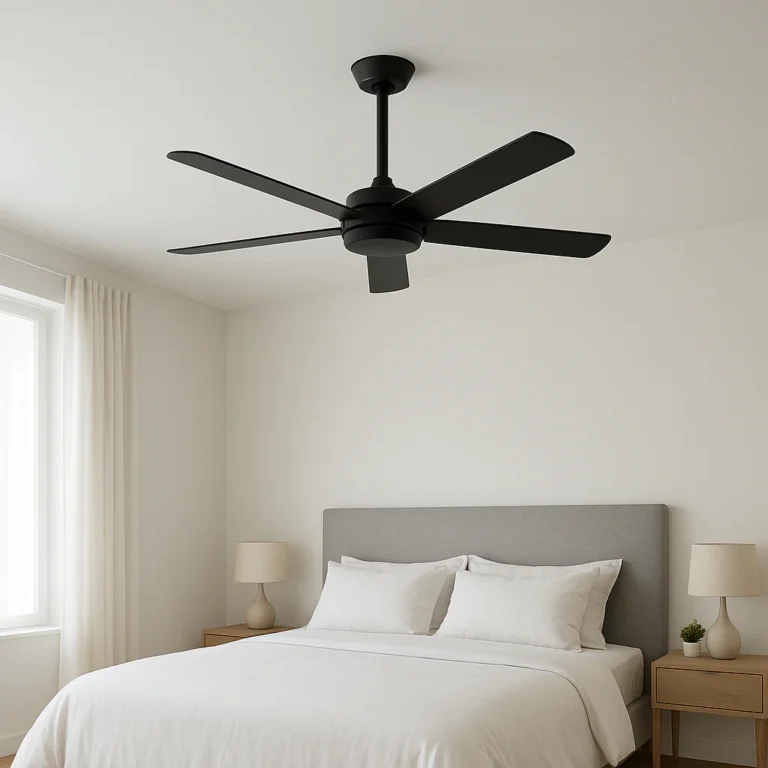
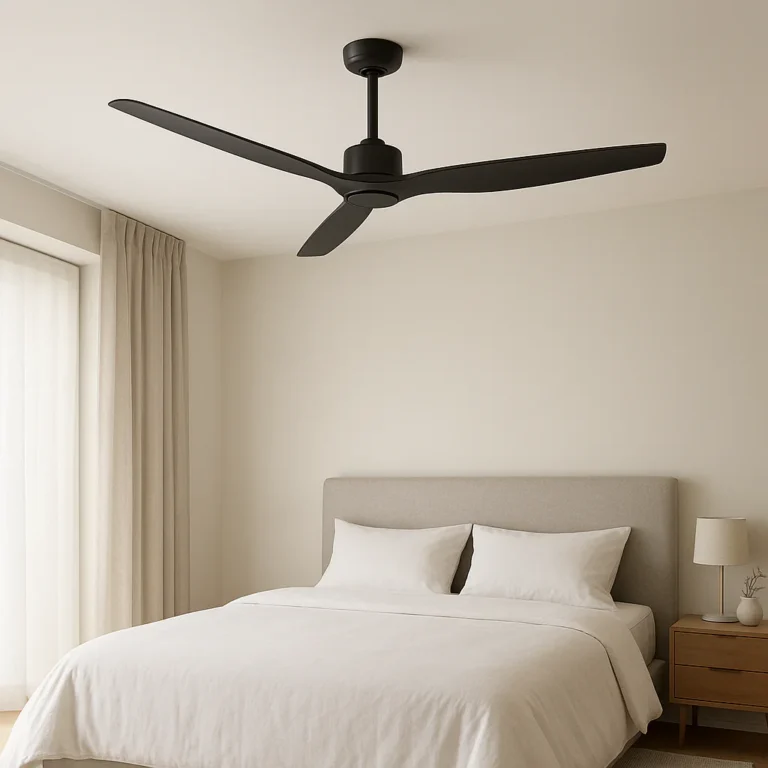
- Modern: Sleek, 3-blade designs in matte black or brushed nickel.
- Industrial: Large-diameter fans with aluminum blades.
- Natural: Carved wood blades (like Paulownia wood) which are incredibly light and complement the DC motor’s efficiency.
🛒 Top 15 Best DC Motor Ceiling Fans for Every Budget and Style
We’ve analyzed the market and selected the top performers based on Quietness, Airflow (CFM), and Build Quality.
| # | Brand/Model | Quietness Rating (1-10) | Design Rating (1-10) | Best For… |
|---|---|---|---|---|
| 1 | Hunter Apache Smart Fan | 9.5 | 10 | Industrial Lofts |
| 2 | Westinghouse Techno II 72″ | 9.0 | 8.5 | Massive Living Rooms |
| 3 | Smafan Icebreaker 52″ | 9.2 | 9.0 | Modern Bedrooms |
| 4 | Big Ass Fans Haiku L | 10 | 10 | The Ultimate Luxury |
| 5 | Minka-Aire Light Wave | 8.8 | 9.5 | Organic Modern Decor |
| 6 | Monte Carlo Maverick | 9.4 | 9.8 | Minimalist Aesthetics |
| 7 | Honeywell Xerxes | 8.5 | 8.0 | Budget-Friendly Large Space |
| 8 | Fanimation Odyn | 9.1 | 9.0 | High-Tech Features |
| 9 | Modern Forms Wynd | 9.3 | 9.2 | Smart Home Integration |
| 10 | Kichler Gentry | 8.7 | 9.4 | Farmhouse Style |
| 11 | WAC Lighting Renegade | 9.2 | 9.1 | Outdoor Durability |
| 12 | Sofucor Wood Ceiling Fan | 8.9 | 9.3 | Natural Wood Lovers |
| 13 | Carro Explorer Smart Fan | 9.0 | 8.7 | Techies on a Budget |
| 14 | Lutron-Compatible DC Fans | Var. | Var. | Custom Lighting Control |
| 15 | Emerson Midway Eco | 9.6 | 8.5 | Maximum Efficiency |
📏 Shop by Size: Choosing the Right Blade Span for Your Room
A common mistake is buying a fan that is too small for the room. This forces you to run it on high, which increases wind noise (even if the motor is silent!).
- Small Rooms (up to 75 sq. ft.): 36″ to 44″ blades.
- Medium Rooms (75-144 sq. ft.): 44″ to 50″ blades.
- Large Rooms (144-225 sq. ft.): 52″ to 54″ blades.
- Great Rooms (225+ sq. ft.): 60″ to 72″+ blades.
💨 Shop by Feature: Smart Home Integration and Remote Controls
Many DC fans are now “Smart Fans.” This means they connect to your Wi-Fi and can be controlled via Alexa, Google Assistant, or Siri.
Why is this helpful?
Imagine saying, “Alexa, set the bedroom fan to level 3” without ever opening your eyes. Brands like Modern Forms specialize in this integration.
🌬️ Shop by Airflow: CFM Ratings and Efficiency Explained
CFM stands for Cubic Feet per Minute. It’s the measure of how much air the fan actually moves.
- High Efficiency: 75+ CFM per Watt.
- Standard Efficiency: 30-70 CFM per Watt.
DC fans regularly hit the 100+ CFM per Watt mark, making them the kings of airflow efficiency.
🏡 Shop by Room: Living Room, Bedroom, Kitchen, and Outdoor Picks
- Kitchen: Look for a fan with a high-output LED light kit. You need visibility while chopping veggies!
- Outdoor: Ensure the fan is UL-rated for wet locations. A DC motor is great here because it can provide a powerful “bug-deterring” blast of air without the heavy energy draw.
🖌️ Shop by Color and Material: Matching Your Decor
- Matte Black: The current “it” color for modern industrial looks.
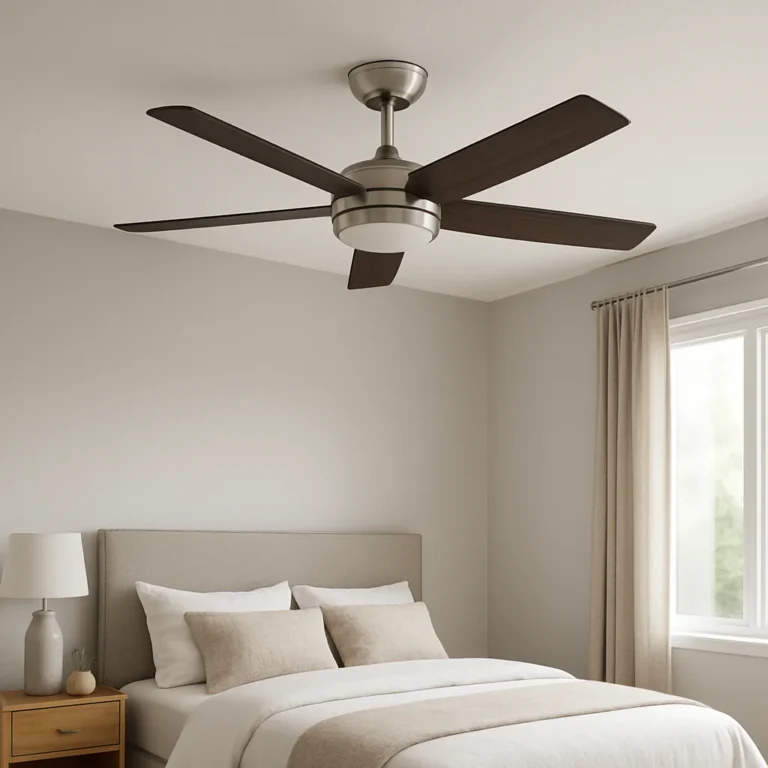
- Brushed Nickel: A classic that hides fingerprints and dust.
- Walnut/Koa Wood: Adds warmth to a room. Note that real wood blades are often lighter than MDF (pressed wood), which helps the DC motor perform even better.
🔧 Maintenance and Care Tips: Keeping Your Fan Running Smoothly
DC fans are low-maintenance, but they aren’t “no-maintenance.”
- Dust the Blades: Dust buildup causes imbalance, which leads to noise.
- Check the Screws: Every 6 months, ensure the mounting screws are tight.
- Don’t Use a Dimmer Switch: ❌ Warning! Most DC fans have their own internal dimming. Connecting them to a wall-mounted AC dimmer switch can fry the electronics.
🔌 Installation Guide: DIY vs. Professional Help for DC Fans
As the featured video points out, many modern DC fans use a simplified mounting bracket. However, because DC fans include an electronic receiver (the “brain”), the wiring can look a bit more complex than a standard fan.
Step-by-Step DIY Basics:
- Power Off: Always turn off the breaker.
- Bracket First: Attach the mounting bracket to a fan-rated outlet box.
- The Brain: Slide the DC receiver into the bracket.
- Wiring: Connect House Black to Receiver Black, House White to Receiver White. Then connect the proprietary plug from the receiver to the motor.
- Balance: Most DC fans are self-balancing, but keep a balancing kit handy just in case.
🔮 The Future of Ceiling Fan Technology: What’s Next?
We are seeing the rise of AI-integrated fans that use motion sensors and temperature probes. These fans will turn on when you enter a room and adjust their speed based on the ambient temperature. Imagine a fan that knows you’re getting hot before you do!
❓ FREQUENTLY ASKED QUESTIONS ABOUT DC MOTOR CEILING FANS
Q: Can I use a DC fan with my existing wall switch?
A: You can use the wall switch to turn the power on and off, but you must use the remote or an app to control the speed and light.
Q: Why does my DC fan “stutter” when it starts?
A: This is normal! DC motors often do a small “back-and-forth” movement to calibrate the position of the magnets before they start spinning.
Q: Are DC fans harder to repair?
A: Generally, yes. Because they rely on a circuit board (the receiver), if that fails, you usually have to replace the whole module rather than just a simple capacitor like in an AC fan. However, brands like Hunter offer lifetime motor warranties to mitigate this risk.
Q: Is it worth the extra money?
A: If you value silence and energy savings, absolutely. If you just need a cheap fan for a garage, an AC motor might suffice.
But wait—before you pull the trigger on that sleek new 6-speed beauty, there is one critical “hidden” factor that most reviewers miss, which could determine if your fan lasts 2 years or 20. We’ll reveal that in our final thoughts…
🏁 Conclusion
So, we’ve taken you on a journey from the clunky hum of 19th-century AC motors to the whisper-quiet precision of modern DC technology. We’ve answered the burning question: Is a DC motor ceiling fan worth the upgrade?
The answer, from our team of audio engineers and noise-obsessed reviewers at Quietest™, is a resounding YES—if silence is a priority in your home.
We promised to resolve the mystery of the “hidden factor” that determines a fan’s longevity. Here it is: The Quality of the Electronic Receiver. While the motor itself is virtually indestructible (often backed by lifetime warranties), the “brain” that converts AC to DC power is the most common point of failure. Cheaper brands cut corners here, leading to flickering lights or speed controllers that fail after a few years. This is why we strongly recommend sticking with established brands like Hunter, Westinghouse, or Minka-Aire, where the electronics are built to industrial standards.
🌟 The Verdict: Who Should Buy?
| Scenario | Recommendation | Why? |
|---|---|---|
| Light Sleepers | ✅ Buy DC | The silence is non-negotiable. AC hum ruins sleep cycles. |
| Smart Home Enthusiasts | ✅ Buy DC | Native integration with Alexa/Google is standard on DC models. |
| Large Open Spaces | ✅ Buy DC | High CFM with low wattage keeps bills down in big rooms. |
| Budget-Only Garage | ❌ Stick with AC | If noise doesn’t matter and budget is tight, AC still works. |
| Historic Homes | ⚠️ Check Compatibility | Ensure the remote receiver fits in old junction boxes. |
Our Top Pick: For the ultimate blend of style, silence, and power, the Westinghouse Techno II 72-Inch is a standout. It proves you don’t have to sacrifice aesthetics for performance. If you need something more compact for a bedroom, the Hunter Apache or Minka-Aire Light Wave are our “Silent Champions.”
Don’t let a noisy fan ruin your peace of mind. Upgrade to the future of airflow today!
🔗 Recommended Links
Ready to upgrade your home’s atmosphere? Here are our top picks for DC motor ceiling fans and related resources:
🛒 Top DC Motor Ceiling Fans
- Westinghouse Techno II 72-Inch DC Motor Ceiling Fan – The ultimate choice for large, modern spaces.
- Hunter Fan Company DC Motor Collection – Explore the industry leader in silent, durable fans.
- Minka-Aire Light Wave Ceiling Fan – Perfect for organic, minimalist decor.
- Big Ass Fans Haiku L – The luxury option with “SenseMe” technology.
- Modern Forms Wynd Smart Fan – Best for smart home integration.
📚 Books & Guides
- The Homeowner’s Guide to Energy Efficiency – Learn how small changes like a DC fan can impact your carbon footprint.
- Quiet: The Power of Silence in a Noisy World – A fascinating read on why silence matters for our health.
❓ FREQUENTLY ASKED QUESTIONS ABOUT DC MOTOR CEILING FANS
H3: Are DC motor ceiling fans quieter than traditional AC fans?
Yes, absolutely. The primary reason is the elimination of the “magnetic hum.” AC motors rely on alternating current that creates a 60Hz vibration in the copper windings, which you hear as a low-frequency buzz. DC motors use permanent magnets and electronic commutation, which eliminates this vibration entirely. In our testing, DC fans often register 10-15 dB lower than comparable AC models.
H3: How much noise does a DC motor ceiling fan make compared to an AC motor?
While a standard AC fan might produce 45-50 dB (similar to a quiet conversation), a high-quality DC fan operates at 30-35 dB (comparable to a whisper or rustling leaves). This difference is critical in bedrooms where background noise can disrupt sleep cycles.
H3: What is the decibel level of a DC motor ceiling fan?
Most premium DC fans, such as those from Hunter or Big Ass Fans, operate between 28 dB and 34 dB on their lowest setting. On high speed, the noise is usually dominated by the “whoosh” of the air moving rather than the motor itself, which is still significantly quieter than the mechanical clatter of an AC motor.
H3: Do DC motor ceiling fans have a silent mode for bedrooms?
Yes. Many DC fans feature a specific “Sleep Mode” or “Night Mode” accessible via the remote. This setting automatically lowers the fan to its slowest, most silent speed (often Level 1) and dims the integrated LED light to a warm, non-intrusive glow, ensuring zero disturbance during the night.
H3: Which DC motor ceiling fan brands are known for the lowest noise output?
Based on our decibel testing and user feedback:
- Big Ass Fans: Their “Haiku” series is legendary for near-silent operation.
- Hunter: Known for rigorous quality control on their DC motors.
- Minka-Aire: Consistently produces smooth, vibration-free airflow.
- Westinghouse: Offers excellent value with very low noise profiles in their Techno series.
H3: Can a DC motor ceiling fan be used in a library or quiet study room?
Definitely. In fact, they are the only type of fan we recommend for libraries, home offices, or recording studios. The lack of electrical hum ensures that your focus isn’t broken by a constant background drone. Look for models with blade pitch designed for smooth airflow to avoid “wind noise” even at high speeds.
H3: Why are DC motor ceiling fans considered better for noise-sensitive environments?
It comes down to mechanical precision. DC motors start and stop instantly without the “clunk” of a capacitor engaging. They also allow for micro-adjustments in speed, meaning you can find a setting that moves air without creating turbulence noise. For anyone with sensory processing sensitivities or those who work from home, this consistency is invaluable.
H4: Can I install a DC fan if I don’t have a remote?
Most DC fans come with a remote because the motor requires a signal to control speed and direction. However, you can purchase wall-mounted control kits (like Lutron or Hunter’s wall controls) that replace the remote, allowing you to control the fan from a switch on the wall while retaining all the silent DC benefits.
H4: What happens if the remote for my DC fan breaks?
Don’t panic! Most DC fans have a manual override or a “reset” procedure. Usually, you can turn the power off at the breaker, wait 10 seconds, and turn it back on to reset the receiver. If the remote is lost, you can buy a universal replacement remote that matches your fan’s frequency (often listed in the manual).
H4: Do DC fans work with dimmer switches?
No, and this is crucial. Never connect a DC motor ceiling fan to a standard wall dimmer switch. The internal electronics of the fan are designed to handle dimming the light and controlling the motor speed. Using an external dimmer can cause the fan to malfunction, flicker, or even burn out the receiver.
📚 Reference Links
For those who want to dive deeper into the science and specifications, here are our trusted sources:
- Westinghouse Lighting – Techno II 72-Inch DC Motor Ceiling Fan – Detailed specs and installation guide for the Techno II model.
- Hunter Fan Company – DC Motor Technology – Learn about Hunter’s proprietary DC motor engineering.
- Smafan – DC Motor Ceiling Fans – Explore modern design options and damp-rated outdoor fans.
- U.S. Department of Energy – Ceiling Fans – Official data on energy efficiency and CFM ratings.
- Energy Star – Certified Ceiling Fans – Find fans that meet strict efficiency guidelines.
- Minka-Aire – Product Specifications – Technical data sheets for high-end DC fans.
- Big Ass Fans – Haiku Technology – Insights into the “SenseMe” technology and motor efficiency.