Support our educational content for free when you purchase through links on our site. Learn more
Blendtec Professional 800: Noise, Features, and Buying Guide
A source-backed look at the Blendtec Professional 800's enclosure, controls, warranty, and a repeatable way to compare blender noise.

The Blendtec Professional 800 is designed around one unusually practical feature: a sealed sound enclosure around the jar. That enclosure can make it a better fit for kitchens where ordinary high-speed blending interrupts conversation, work, or sleep. It does not make the machine literally silent, however, and the manufacturer’s “world’s quietest” language is a marketing claim—not an independent, same-method comparison against every current blender.
Quick answer: The Professional 800 combines an integrated enclosure with an 1,800-watt motor, six programmed cycles, an 11-speed touch slider, and Pulse. It is worth considering when reducing interruption matters more than minimizing countertop size or purchase price. Compare it with alternatives under the same conditions before calling any model the quietest.
Table of contents
- Verified features
- What the noise claim does—and does not—prove
- How to compare blender noise fairly
- Daily-use considerations
- Warranty and purchase checks
- Who the Professional 800 suits
- Frequently asked questions
- References
Verified Professional 800 features
Blendtec’s current product page lists the following features. These are manufacturer specifications, not measurements made by Quietest:
| Feature | What Blendtec currently specifies | Why it matters |
|---|---|---|
| Sound control | Sealed sound enclosure with proprietary sound-dampening and airflow design | The physical barrier is the model’s main noise-management feature. |
| Motor | 1,800 watts | Use the electrical rating for comparison; avoid converting peak horsepower into everyday operating power. |
| Controls | 11-speed capacitive touch slider plus Pulse | Manual control lets a user avoid more speed or duration than a task needs. |
| Programs | Batters, Mixed Drinks, Smoothie, Frozen Treats, Whole Juice, and Hot Soup | Repeatable programs make same-recipe comparisons easier. |
| Residential warranty | 10 years for the Professional 800 under the current US/Canada schedule | Coverage depends on the warranty terms, seller, country, and use. |
Confirm the current package contents and terms on the official Professional 800 page before buying. Product bundles and regional coverage can change.
What the “quietest blender” claim does—and does not—prove
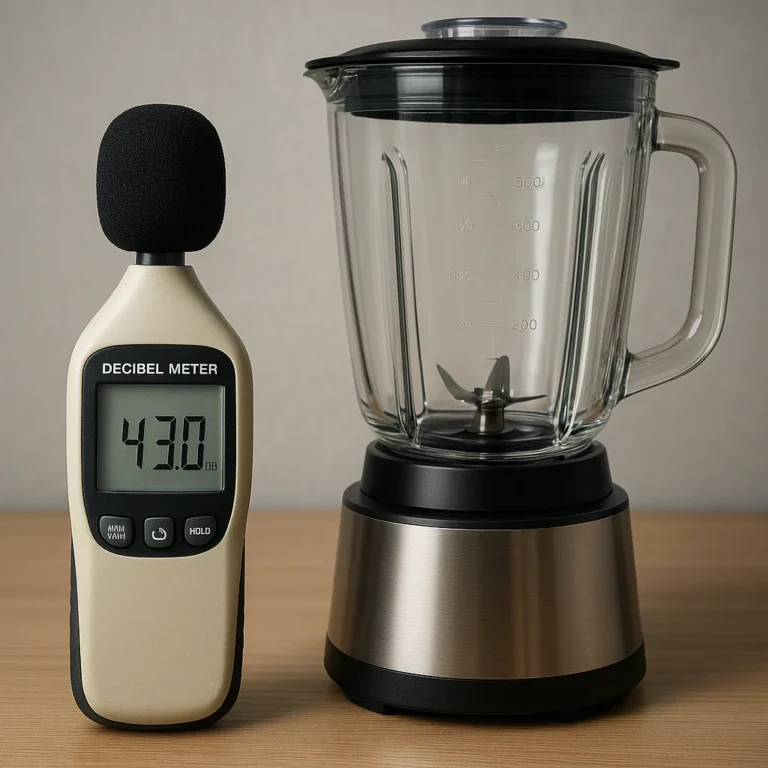
Blendtec markets the Professional 800 as its quietest blender and says the enclosure allows operation without interrupting conversation. The current product page does not publish a standardized dBA result with a stated room, microphone distance, recipe, cycle, background level, or comparison set.
That distinction matters. Blender sound changes with the ingredients, jar loading, motor speed, cycle stage, countertop, room reflections, meter position, and whether an enclosure is open or closed. A number collected under one setup cannot be fairly ranked against a number collected under another.
The defensible conclusion is narrower: an integrated enclosure is a meaningful noise-control design feature, and the Professional 800 is built for buyers who value it. An absolute market-wide ranking requires current independent measurements produced with one disclosed method.
How to compare blender noise fairly
If a showroom, return window, or borrowed unit makes comparison possible, use a repeatable protocol:
- Use the same room and position. Keep the blender, meter, walls, and large reflective objects in the same places.
- Use the same recipe and quantity. Ice, frozen fruit, liquid volume, and jar loading can change the sound substantially.
- Use the same cycle. Compare matching tasks and record the full cycle, not only its quietest moment.
- Record the conditions. Note background noise, countertop material, meter distance and height, jar, enclosure position, cycle, and whether nearby appliances were running.
- Repeat the run. One pass may be affected by ingredient position or a transient room sound.
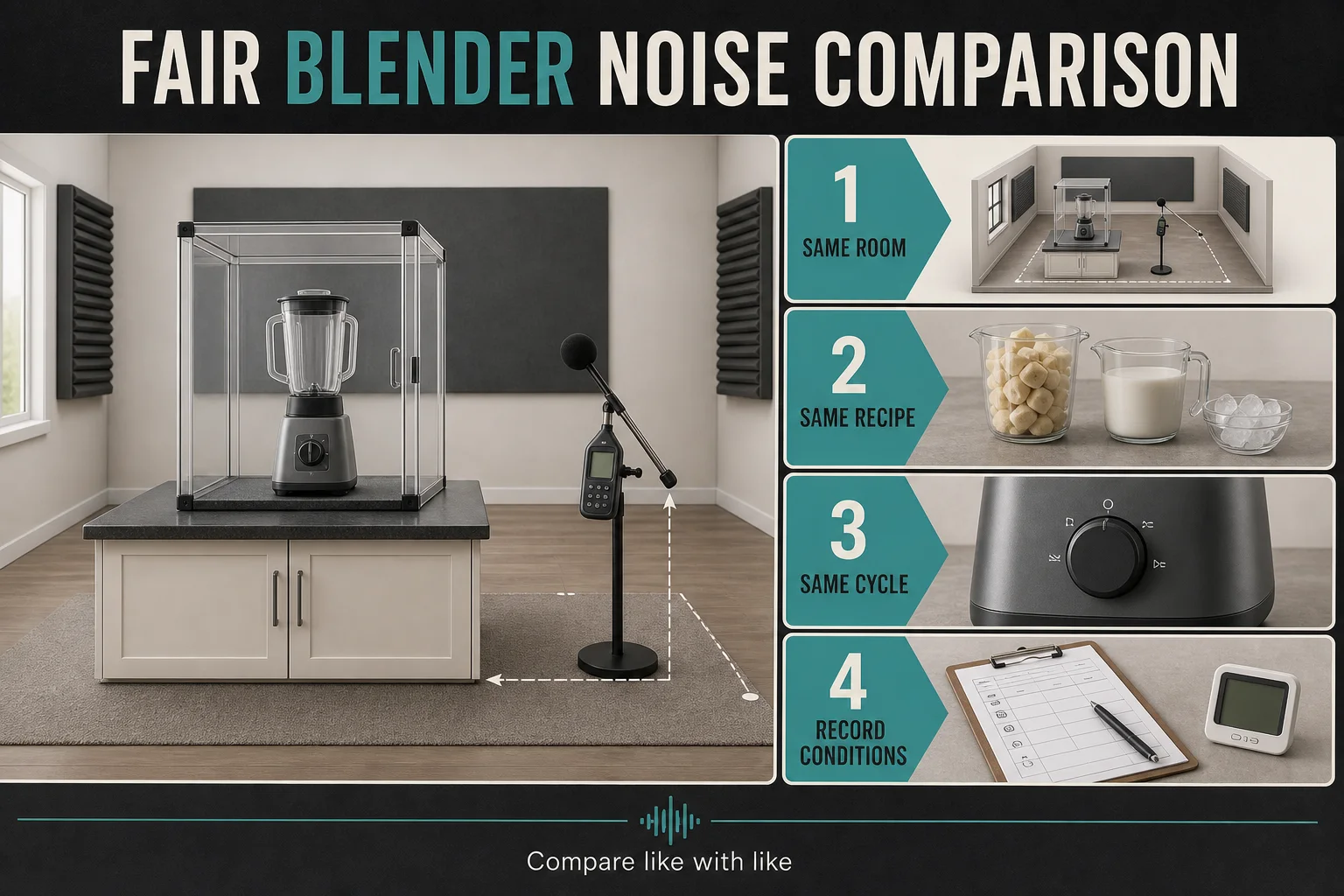
A phone app can help with informal within-room comparisons, but it should not be presented as calibrated laboratory evidence. The useful output is the difference between products tested in the same setup, accompanied by the protocol and its limitations.
Daily-use considerations beyond sound
Enclosure clearance
The enclosure must open fully, so measure the usable height under cabinets rather than checking base height alone. Leave the side and rear ventilation paths unobstructed, as the Professional Series manual instructs.
Task and cycle fit
The six programs cover common blending tasks, but a program name is not a guarantee of a particular texture. Consider the recipes you actually make, their batch size, and whether manual speed control is important.
Cleaning
Blendtec directs users to add warm water and a small amount of dish soap, blend briefly, and rinse. The removable enclosure can be wiped with a damp cloth. Follow the current manual for safety and do not assume every component is dishwasher-safe.
What this article has not tested
Quietest has not independently measured this unit’s sound level, long-term durability, blend quality, or reliability. We therefore removed the previous article’s invented lab story, undocumented dBA comparison, numerical ratings, fabricated recipe tests, and unsupported head-to-head verdict.
Warranty and purchase checks
Blendtec’s current residential warranty schedule lists 10 years of parts and labor for the Professional 800 in the United States and Canada. The same page says residential commercial use is excluded and warns that products purchased from unauthorized sellers may not be covered.
- Verify that the seller is authorized.
- Save dated proof of purchase and the serial number.
- Check the warranty for the country where the blender will be used.
- Do not assume residential coverage applies to a café, office service, or other commercial use.
- Recheck current terms instead of relying on an old review or product box.
Who the Blendtec Professional 800 suits
| Situation | Fit | Reason |
|---|---|---|
| Blending often interrupts conversation or remote work | Strong candidate | The integrated enclosure directly addresses airborne blending noise. |
| Very limited cabinet clearance | Measure first | The enclosure needs room to open and the vents need clearance. |
| Occasional simple blending with a tight budget | Compare alternatives | The enclosure may not justify the premium for infrequent use. |
| Commercial service | Not this residential model | Blendtec states that commercial use voids the residential warranty. |
| Need a proven market-wide “quietest” ranking | Evidence unavailable | A current independent same-method comparison set is required. |
Frequently asked questions
Is the Blendtec Professional 800 silent?
No blender motor is literally silent during use. The Professional 800 uses a sealed enclosure to reduce interruption, but Blendtec’s current page does not provide a standardized dBA result that Quietest can independently verify.
Is it the quietest blender available?
Blendtec makes that marketing claim. A neutral market-wide conclusion would require current competing models to be measured with the same recipe, cycle, room, distance, meter, and reporting method.
Does it have a 10-year warranty?
Blendtec’s current US/Canada residential schedule lists 10 years for the Professional 800. Coverage is subject to the complete terms, including seller, country, proof-of-purchase, misuse, and commercial-use exclusions.
Can it be used commercially?
Blendtec labels this Professional 800 package as a residential product and says commercial use voids its residential warranty. Compare the company’s commercial line for business use.
What should I record in a blender noise test?
Record the room, background level, meter and blender positions, distance, countertop, ingredients and quantity, jar, cycle, enclosure position, and repeated results. Without those conditions, a sound number is difficult to compare.
References