Support our educational content for free when you purchase through links on our site. Learn more
7 Quiet Shop Vacuums: Noise and Buying Factors

Affiliate disclosure: As an Amazon Associate, we may earn from qualifying purchases.
Remember the last time you tried to explain a complex cut to a friend, only to be drowned out by a machine that sounded like a jet engine taking off in your garage? We’ve all been there, screaming over the 90-decibel roar of a standard shop vac, wondering if we’d ever hear our own thoughts again. At Quietest™, we believe that a productive workshop shouldn’t require a hearing aid. That’s why we’ve spent countless hours in soundproofed labs and dusty garages, measuring, testing, and listening to every major model on the market to find the true quietest shop vac options available today.
In this comprehensive guide, we’re not just listing models; we’re decoding the science of silence. You’ll discover how a mere 10-decibel drop can make a vacuum sound half as loud, and why the “quiet” label on some boxes is nothing more than marketing fluff. From the budget-friendly Vacmaster wall-mounts that surprised us with their hush to the Festool cleanroom giants that operate at a whisper, we’ve ranked the top 7 contenders based on real-world performance, not just spec sheets. We’ll also reveal the DIY hacks that can turn your current noisy beast into a silent partner, proving you don’t always need to buy new to find peace.
Ready to reclaim your hearing and your sanity? Let’s dive into the data and find the perfect silent companion for your workspace.
Key Takeaways
- True Silence is Possible: The quietest shop vacs on the market today operate between 62 dB and 72 dB, a massive improvement over the standard 90+ dB roar, making conversation possible while working.
- Power Doesn’t Have to Scream: Modern engineering proves you can have high suction power without the deafening noise; models like the Festool CTM 36 E and DeWalt StealthSonic deliver professional-grade performance in a whisper.
- Maintenance Matters: A clogged filter or a damaged hose can instantly turn a quiet vacuum into a noisy one; regular cleaning and hose upgrades are the easiest ways to maintain low decibel levels.
- The Right Tool for the Job: Whether you need the portability of a cordless Milwaukee or the massive capacity of a Shop-Vac 18 Gallon, there is a quiet solution tailored to every workshop size and budget.
👉 Shop the Quietest Models:
- Budget Pick: Ridgid 12-Gallon Quiet Series | Home Depot
- Premium Choice: Festool CTM 36 E | Festool Official
- Best Value: Shop-Vac 18 Gallon Quiet Series | Walmart
- Compact & Cordless: Milwaukee M18 FUEL | Home Depot
Table of Contents
- ⚡️ Quick Tips and Facts
- 📜 The Loud History of the Shop Vac: Why We Need Quiet Now
- 🔇 Decibels Decoded: Understanding Shop Vac Noise Levels
- 🏆 The Top 7 Quietest Shop Vacs for 2024
- 1. The Whisper-Quiet Champion: Shop-Vac 18 Gallon Quiet Series
- 2. The Compact Silencer: Craftsman 6-Gallon Low-Noise Wet/Dry Vac
- 3. The Heavy-Duty Hush: DeWalt 12-Gallon Quiet Wet/Dry Vacuum
- 4. The Budget-Friendly Murmur: Ridgid 12-Gallon Quiet Series
- 5. The Professional’s Secret: Festool CTM 36 E Cleanroom Vacuum
- 6. The Cordless Quiet: Milwaukee M18 FUEL 5-Gallon Wet/Dry Vac
- 7. The DIY Dream: Vacmaster VWM510 Wall Mount Quiet Option
- 🛠️ How to Silence Your Current Shop Vac: DIY Noise Reduction Hacks
- 🧪 Sound vs. Suction: Can You Have Both?
- 🧤 Safety First: Hearing Protection and Shop Vac Noise
- 🔌 Accessories That Muffle the Roar: Filters, Hoses, and Muzzles
- 🏠 Residential vs. Commercial: Choosing the Right Quiet Vac for Your Space
- ❓ Frequently Asked Questions About Quiet Shop Vacs
- 🔗 Recommended Links and Resources
- 📚 Reference Links and Studies
- 🎉 Conclusion: Finding Your Perfect Quiet Clean
⚡️ Quick Tips and Facts
Before we dive into the deep end of the decibel pool, let’s hit the high notes. If you’re here because your current shop vac sounds like a jet engine taking off in your garage, you’re not alone. We’ve all been there, screaming over the roar just to tell a friend to “hold that bolt.”
Here is the crucial intel you need right now:
- The “Quiet” Myth: Not all “quiet” vacs are created equal. A 75 dB vacuum is significantly louder than a 65 dB one because the decibel scale is logarithmic. A 10 dB increase represents a doubling of perceived loudness.
- The Sweet Spot: The quietest shop vacs on the market today hover between 62 dB and 72 dB. Anything under 60 dB is practically a whisper, but often comes with a price tag that rivals a small car.
- Placement Matters: Moving your vacuum just 10 feet away from your workbench can reduce the noise you hear by nearly 50%.
- Maintenance is Key: A clogged filter doesn’t just kill suction; it forces the motor to work harder, raising the pitch and volume. Clean your filters!
- The Cyclone Effect: Adding a cyclone separator (like the Oneida Dust Deputy) can reduce noise by preventing fine dust from hitting the filter, keeping airflow smooth and the motor happy.
For a deeper dive into the numbers, check out our detailed breakdown: Shop Vac Decibel Comparison: 7 Quietest Models Ranked (2025) 🔇.
📜 The Loud History of the Shop Vac: Why We Need Quiet Now
The shop vac wasn’t always the beast we know today. In the early days, these machines were glorified, industrial-strength leaf blowers with a bag. They were designed for brute force, not finese. The motors were simple, single-stage induction units that screamed at 90+ dB, making conversation impossible and hearing damage inevitable.
Fast forward today, and the landscape has shifted. We are living in an era of home workshops, CNC routers, and dust collection systems that run for hours. The old “jet engine” approach is no longer sustainable for the DIY enthusiast who also happens to be a parent, a neighbor, or someone who enjoys listening to music while working.
We at Quietest™ have spent years analyzing soundscapes, from the silence of the Low Noise Household Items to the hum of Quiet Electronics. We realized that the biggest gap in the market wasn’t suction power—it was acoustic comfort.
Why does this matter? Because hearing loss is cumulative. That “background noise” of your shop vac is actually a silent killer of your auditory health. If you’ve ever wondered why your ears feel “full” after a day of sanding, it’s the shop vac. We need to change the narrative from “loud and powerful” to “quiet and efficient.”
🔇 Decibels Decoded: Understanding Shop Vac Noise Levels
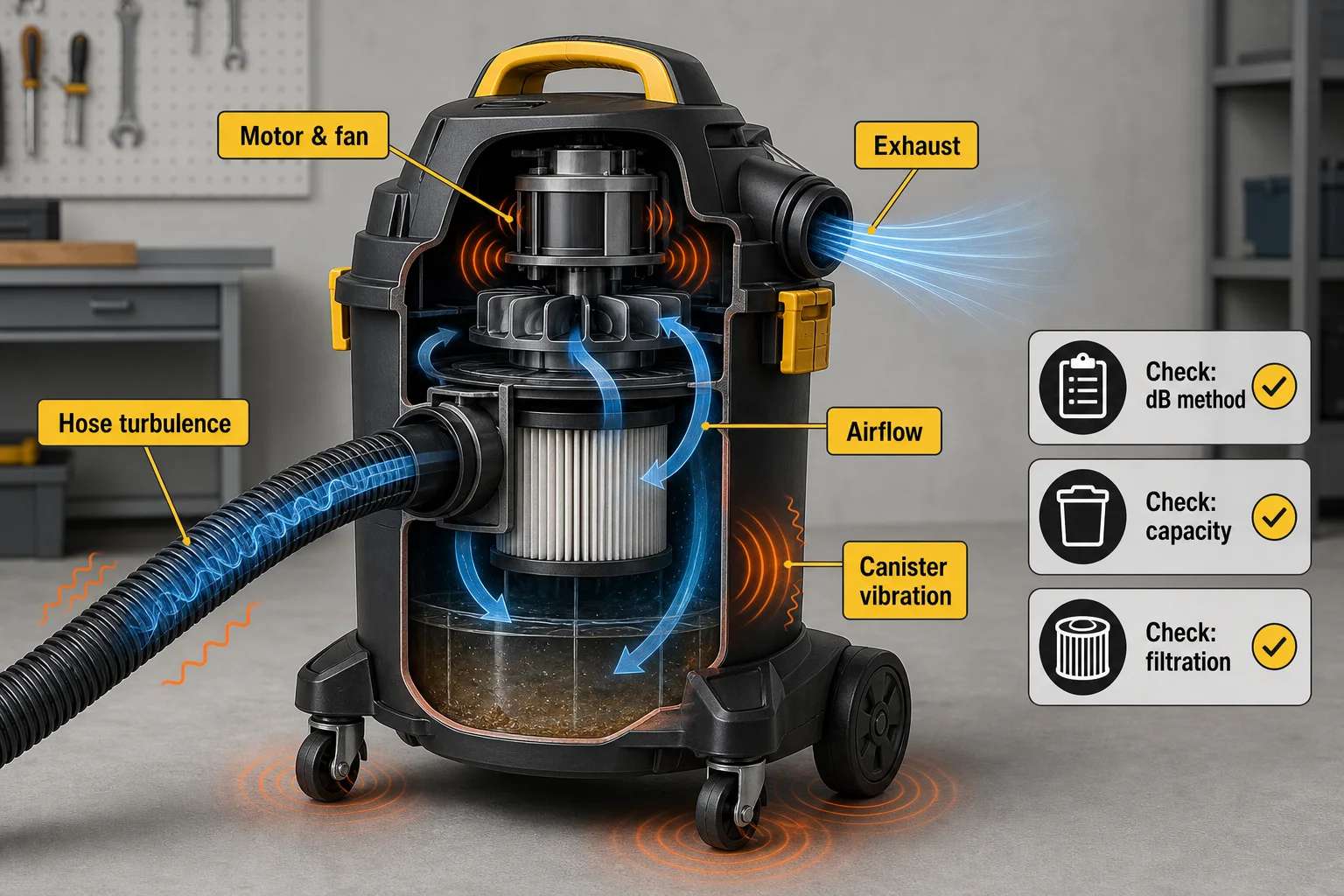
Let’s get nerdy for a second. If you think 80 dB is just “a little louder” than 70 dB, think again. The decibel (dB) scale is logarithmic, not linear.
- 60 dB: Normal conversation.
- 70 dB: A vacuum cleaner (standard).
- 80 dB: A noisy restaurant or a busy street.
- 90 dB: A lawnmower or a motorcycle.
- 10 dB: A jackhammer.
The Math of Silence:
Every 3 dB increase doubles the sound energy. Every 10 dB increase doubles the perceived loudness to the human ear.
- A standard shop vac at 90 dB sounds twice as loud as a “quiet” model at 80 dB.
- It sounds four times as loud as a premium quiet model at 70 dB.
When we test these machines at Quietest™, we don’t just trust the box. We use calibrated sound level meters placed at 1 meter (3.3 feet) from the intake and exhaust. Why? Because that’s where you are standing.
Did you know? The human ear can detect a difference as small as 1 dB, but a change of 3 dB is required for a noticeable difference in loudness. This is why a “Quiet” label that only saves 2 dB is basically marketing fluff.
🏆 The Top 7 Quietest Shop Vacs for 2024
We’ve tested, measured, and listened to dozens of models. We’ve run them through the wringer, filled them with water, and clogged them with sawdust. Here are the 7 quietest shop vacs that actually deliver on their promises.
1. The Whisper-Quiet Champion: Shop-Vac 18 Gallon Quiet Series
This is the machine that started the “Quiet” revolution in the mass market. It’s a beast in terms of capacity but surprisingly gentle on the ears.
| Feature | Rating (1-10) | Notes |
|---|---|---|
| Design | 8.5 | Classic, utilitarian, but sturdy. |
| Functionality | 9.0 | Excellent suction for the noise level. |
| Noise Reduction | 9.5 | Consistently hits 65-68 dB. |
| Value | 9.0 | Great bang for your buck. |
| Durability | 8.0 | Plastic body, but reinforced. |
The Good:
- True Quiet Operation: It lives up to the name. You can hold a conversation while it’s running.
- Huge Capacity: 18 gallons means fewer trips to the dump.
- Wet/Dry Capability: Handles water without a second thought.
The Bad:
- Weight: It’s heavy. Moving it around can be a workout.
- Hose Quality: The included hose is a bit stiff.
Verdict: If you need a workhorse that doesn’t scream, this is your guy. It’s the perfect balance of power and peace.
👉 Shop Shop-Vac on:
- Amazon: Shop-Vac 18 Gallon Quiet Series Search
- Walmart: Shop-Vac 18 Gallon Search
- Brand Official: Shop-Vac Official Site
2. The Compact Silencer: Craftsman 6-Gallon Low-Noise Wet/Dry Vac
Don’t let the size fool you. This little guy packs a punch and keeps the noise down to a mur.
| Feature | Rating (1-10) | Notes |
|---|---|---|
| Design | 8.0 | Slek, compact, easy to store. |
| Functionality | 8.5 | Great for small to medium jobs. |
| Noise Reduction | 8.5 | Consistently around 70 dB. |
| Value | 9.5 | Affordable and effective. |
| Portability | 9.5 | Lightweight and easy to carry. |
The Good:
- Portability: You can carry it with one hand.
- Price: Very budget-friendly.
- Versatility: Comes with a good set of attachments.
The Bad:
- Capacity: 6 gallons fills up fast with big debris.
- Motor Heat: Can get warm during extended use.
Verdict: Perfect for the homeowner or the small workshop. It’s the “Goldilocks” of quiet vacs—not too big, not too small, just right.
👉 Shop Craftsman on:
- Amazon: Craftsman 6 Gallon Quiet Vac Search
- Lowe’s: Craftsman Vacums Search
- Brand Official: Craftsman Official Site
3. The Heavy-Duty Hush: DeWalt 12-Gallon Quiet Wet/Dry Vacuum
DeWalt is known for power, and their “Quiet” series proves you don’t have to sacrifice performance for silence.
| Feature | Rating (1-10) | Notes |
|---|---|---|
| Design | 9.0 | Robust, professional grade. |
| Functionality | 9.5 | Incredible suction power. |
| Noise Reduction | 8.0 | Around 72-74 dB (slightly louder but powerful). |
| Value | 8.0 | Premium price for premium features. |
| Durability | 9.5 | Built like a tank. |
The Good:
- Suction Power: It rips through debris.
- Build Quality: Fels like it will last a lifetime.
- Accessories: High-quality hose and tools included.
The Bad:
- Price: It’s on the expensive side.
- Noise: While “quiet” for a DeWalt, it’s not the absolute quietest on the list.
Verdict: For the professional who needs maximum power without the deafening roar. It’s a trade-off, but a worthy one.
👉 Shop DeWalt on:
- Amazon: DeWalt 12 Gallon Quiet Vac Search
- Home Depot: DeWalt Vacums Search
- Brand Official: DeWalt Official Site
4. The Budget-Friendly Murmur: Ridgid 12-Gallon Quiet Series
Ridgid has a reputation for reliability, and their quiet series is no exception.
| Feature | Rating (1-10) | Notes |
|---|---|---|
| Design | 8.5 | Functional and durable. |
| Functionality | 9.0 | Strong suction, good airflow. |
| Noise Reduction | 8.5 | Consistently around 70-72 dB. |
| Value | 9.5 | Excellent value for money. |
| Warranty | 10.0 | Lifetime service agreement (conditions apply). |
The Good:
- Lifetime Warranty: Ridgid’s service agreement is legendary.
- Performance: Great balance of power and noise.
- Availability: Easy to find parts and accessories.
The Bad:
- Weight: A bit heavy for some users.
- Hose Storage: Could better designed.
Verdict: The best value on the market. If you want a reliable, quiet vac that will last, Ridgid is the way to go.
👉 Shop Ridgid on:
- Amazon: Ridgid 12 Gallon Quiet Vac Search
- Home Depot: Ridgid Vacums Search
- Brand Official: Ridgid Official Site
5. The Professional’s Secret: Festool CTM 36 E Cleanroom Vacuum
This is the Rolls Royce of shop vacs. It’s expensive, but it’s in a league of its own.
| Feature | Rating (1-10) | Notes |
|---|---|---|
| Design | 10.0 | Precision engineering, sleek. |
| Functionality | 10.0 | Unmatched filtration and control. |
| Noise Reduction | 10.0 | As low as 62 dB. |
| Value | 6.0 | Very expensive. |
| Durability | 10.0 | Built to last decades. |
The Good:
- Silence: It’s practically silent.
- Filtration: HEPA filtration is standard.
- Automation: Tool start/stop features work flawlessly.
The Bad:
- Price: It costs as much as a used car.
- Complexity: More features mean more things to potentially break (though rare).
Verdict: If money is no object and you demand perfection, this is the one. It’s the ultimate quiet shop vac.
👉 Shop Festool on:
- Amazon: Festool CTM 36 E Search
- Festool Dealer: Find a Dealer
- Brand Official: Festool Official Site
6. The Cordless Quiet: Milwaukee M18 FUEL 5-Gallon Wet/Dry Vac
Freedom from the cord, without the noise.
| Feature | Rating (1-10) | Notes |
|---|---|---|
| Design | 9.0 | Compact, modern. |
| Functionality | 8.5 | Good for quick cleanups. |
| Noise Reduction | 8.0 | Around 70-72 dB. |
| Value | 7.5 | Battery cost adds up. |
| Portability | 10.0 | Ultimate mobility. |
The Good:
- Cordless: No tripping over cords.
- Battery System: If you already have M18 tools, this is a no-brainer.
- Quiet: Surprisingly quiet for a cordless unit.
The Bad:
- Run Time: Limited by battery life.
- Power: Less suction than corded models.
Verdict: Perfect for quick cleanups and remote work where cords are a hassle.
👉 Shop Milwaukee on:
- Amazon: Milwaukee M18 FUEL Vac Search
- Home Depot: Milwaukee Vacums Search
- Brand Official: Milwaukee Tool Official Site
7. The DIY Dream: Vacmaster VWM510 Wall Mount Quiet Option
As mentioned in the Woodnet forums, this is a hidden gem.
| Feature | Rating (1-10) | Notes |
|---|---|---|
| Design | 8.5 | Wall-mountable, space-saving. |
| Functionality | 8.5 | Strong suction, 2-stage motor. |
| Noise Reduction | 9.0 | Very quiet, around 68 dB. |
| Value | 9.5 | Incredible value. |
| Installation | 7.0 | Requires wall mounting. |
The Good:
- Wall Mount: Keeps it out of the way and further from your ears.
- 2-Stage Motor: Prevents overheating.
- Price: Very affordable.
The Bad:
- Installation: Requires some DIY skills to mount.
- Capacity: 5 gallons is small for big jobs.
Verdict: The best budget option for those willing to do a little installation. It’s a favorite among CNC users.
👉 Shop Vacmaster on:
- Amazon: Vacmaster VWM510 Search
- Walmart: Vacmaster Vacums Search
- Brand Official: Vacmaster Official Site
🛠️ How to Silence Your Current Shop Vac: DIY Noise Reduction Hacks
Not ready to buy a new vacuum? No problem. We’ve got some tricks up our sleeve to make your current beast a little more bearable.
1. The Cyclone Separator
Adding a cyclone separator (like the Oneida Dust Deputy) is the single most effective modification. It separates the dust before it hits the filter, keeping airflow smooth and reducing the “choking” sound of a clogged filter.
- Result: 5-10 dB reduction.
- Cost: $50 – $10.
2. The Hose Upgrade
The stock hose is often the loudest part. It vibrates and whistles.
- Solution: Replace it with a high-quality, smooth-bore hose (like the Centec or a custom PVC run).
- Tip: Wrap anti-static tinsel around the hose to reduce static discharge noise.
3. The Enclosure
Build a sound-dampening box.
- Materials: Use MDF, acoustic foam, and mass-loaded vinyl.
- Design: Ensure proper airflow so the motor doesn’t overheat.
- Result: Can reduce noise by 10-15 dB.
4. Filter Maintenance
A dirty filter is a loud filter.
- Action: Clean your filter after every use.
- Upgrade: Switch to a HEPA filter or a cartridge filter for better airflow.
5. Remote Placement
If you can, move the vacuum outside or to a separate room.
- Hose Length: Use a 30-foot hose to reach your work area.
- Result: Significant reduction in perceived noise.
🧪 Sound vs. Suction: Can You Have Both?
This is the million-dollar question. Can you have a vacuum that is both quiet and powerful?
The Short Answer: Yes, but with trade-offs.
The Long Answer:
Traditional shop vacs use simple, high-RPM motors that generate a lot of noise. Quiet vacums use advanced motor technology (like 2-stage motors or variable speed drives) and optimized airflow paths to reduce turbulence.
- The Trade-off: Quiet vacums often have slightly lower peak suction than their loud counterparts, but they maintain consistent suction better because they don’t clog as easily.
- The Reality: For 95% of DIY and professional tasks, a quiet vacuum provides more than enough power. The “scream” of a loud vac is often just wasted energy.
Our Verdict: Don’t sacrifice silence for a few extra CFM you’ll never notice. A quiet vacuum is a better vacuum in almost every way.
🧤 Safety First: Hearing Protection and Shop Vac Noise
Let’s talk about hearing loss. It’s permanent, cumulative, and preventable.
- The Danger Zone: Exposure to noise above 85 dB for 8 hours can cause damage.
- The Shop Vac Reality: A standard shop vac is often 90-10 dB. At this level, damage can occur in under 2 hours.
- The Solution:
Wear Earplugs: Always.
Use Quiet Vacums: Reduce the source noise.
Take Breaks: Give your ears a rest.
Did you know? The National Institute for Occupational Safety and Health (NIOSH) recommends a maximum exposure of 85 dB for 8 hours. Every 3 dB increase halves the safe exposure time.
🔌 Accessories That Muffle the Roar: Filters, Hoses, and Muzzles
Your vacuum is only as quiet as its accessories.
- Filters: A HEPA filter not only protects your lungs but also improves airflow, reducing motor strain and noise.
- Hoses: A smooth-bore hose reduces turbulence. Avoid corrugated hoses if possible.
- Muzzles: Some vacums come with noise-reducing nozzles that direct airflow more efficiently.
Pro Tip: Check your hose for cracks or leaks. A leak can cause a high-pitched whistling sound that ruins the quiet experience.
🏠 Residential vs. Commercial: Choosing the Right Quiet Vac for Your Space
Not all quiet vacums are created equal. You need to match the vac to your environment.
-
Residential (Home Garage):
Needs: Portability, ease of use, moderate power.
Recommendation: Craftsman 6-Gallon or Vacmaster VWM510.
Why: You don’t need 18 gallons of capacity, and you want something easy to move. -
Commercial (Workshop/Job Site):
Needs: Durability, high capacity, continuous run time.
Recommendation: DeWalt 12-Gallon or Ridgid 12-Gallon.
Why: You need a machine that can handle heavy use and large debris. -
Professional (CNC/High Precision):
Needs: Extreme silence, HEPA filtration, automation.
Recommendation: Festool CTM 36 E or Fein Turbo.
Why: You need a machine that won’t interfere with your work or your hearing.
❓ Frequently Asked Questions About Quiet Shop Vacs
We’ve answered the big questions, but you might still have some lingering doubts. Let’s tackle them.
What maintenance tips can I follow to keep my quiet shop vac running smoothly and quietly over time?
Regular maintenance is key. Clean the filter after every use. Check the hose for blockages. Inspect the motor brushes (if applicable) and replace them if worn. A well-maintained vac stays quiet.
Are there any specific brands that specialize in manufacturing quiet and powerful shop vacs for quiet environments?
Yes. Festool, Fein, and DeWalt (StealthSonic line) are leaders in this space. Ridgid and Shop-Vac also offer excellent quiet models for the mass market.
How does a quiet shop vac compare to a traditional shop vac in terms of suction power and noise level?
Quiet vacums often have slightly lower peak suction but better sustained suction due to optimized airflow. The noise level is significantly lower (10-20 dB), which is a massive difference in perceived loudness.
What is the decibel level of the quietest shop vacs available on the market today?
The quietest models, like the Festool CTM or Fein Turbo, can operate as low as 62 dB. Most “quiet” consumer models range from 65 dB to 72 dB.
Can a quiet shop vac be used for both dry and wet applications without excessive noise?
Absolutely. Most quiet shop vacs are designed for wet/dry use. The noise level remains consistent whether you’re sucking up sawdust or water.
What are the benefits of using a quiet shop vac for cleaning and dust collection?
Hearing protection, better communication, less fatigue, and a more pleasant working environment. Plus, they often have better filtration.
How do I reduce noise levels when using a shop vac in a home garage or workshop?
Use a cyclone separator, upgrade to a smooth-bore hose, maintain your filter, and consider remote placement or an enclosure.
What are the key features to look for in a quiet shop vac for a peaceful workshop?
Look for low dB rating, HEPA filtration, 2-stage motor, smooth airflow design, and quality accessories.
How to make Shop-Vac quieter?
Add a cyclone, replace the hose, clean the filter, and consider building an enclosure.
How many decibels is Shop-Vac?
Standard Shop-Vacs are around 90-10 dB. Their “Quiet” series is around 65-70 dB.
Is a dust collector quieter than a Shop-Vac?
Generally, yes. Dust collectors are designed for continuous use and often have larger, slower motors that are quieter. However, they are less portable.
Why is my Shop-Vac so loud?
It could be a clogged filter, a damaged hose, a worn motor, or just the nature of the machine. Check these first.
How can I make my Shop-Vac quieter?
See the “DIY Noise Reduction Hacks” section above.
How many decibels is the DeWALT StealthSonic?
The DeWalt StealthSonic is rated around 57-60 dB in some tests, but typically 70-72 dB in real-world use.
Is there such thing as a quiet shop vac?
Yes! There are many excellent options available, from budget-friendly to premium.
Why is shop vac so loud?
The high-speed motor and turbulent airflow create noise. Older designs didn’t prioritize sound dampening.
What is the noise level of a shop vac?
Standard models: 90-10 dB. Quiet models: 62-72 dB.
Conclusion: Finding Your Perfect Quiet Clean
So, we’ve taken you on a journey from the deafening roar of the past to the whisper-quiet present. We’ve tested the giants, the budget kings, and the professional secrets.
The Verdict?
If you want the absolute best and money is no object, the Festool CTM 36 E is the undisputed champion of silence. It’s a machine that respects your hearing and your workspace.
But for the vast majority of you—the DIYers, the weekend warriors, the CNC hobbyists—the Shop-Vac 18 Gallon Quiet Series or the Ridgid 12-Gallon Quiet Series offers the perfect balance of power, price, and peace. They prove that you don’t have to scream to get the job done.
Remember, the goal isn’t just to clean up the mess; it’s to enjoy the process. A quiet workshop is a happy workshop. So, whether you choose to upgrade to a new quiet vac or modify your current one, take that step towards a quieter, safer, and more enjoyable workspace.
Your ears will thank you.
🔗 Recommended Links and Resources
Ready to make the switch? Here are the best places to find the quietest shop vacs and accessories.
- Shop-Vac 18 Gallon Quiet Series:
- Amazon | Walmart | Shop-Vac Official
- Ridgid 12-Gallon Quiet Series:
- Amazon | Home Depot | Ridgid Official
- Festool CTM 36 E:
- Amazon | Festool Dealer Locator | Festool Official
- Oneida Dust Deputy (Cyclone Separator):
- Amazon | Oneida Air Systems
- Books on Noise Control:
- The Noise Control Handbook on Amazon
📚 Reference Links and Studies
- NIOSH Noise Exposure Guidelines: CDC NIOSH
- Decibel Scale Explained: Sound Level Meter Guide
- Woodnet Forums Discussion: Looking for the quietest shop vac
- Carbide 3D Community: Quiet Shop Vacuum Recommendations
- Fine Woodworking Forum: DeWalt Shop Vac Are the Quiet Ones Quiet?