Inside the Quietest Room in the World: $5 Million Challenge Winner? đŸ€« (2026)

Imagine stepping into a room so silent that you can hear your own heartbeat echoing like a drum solo in an empty stadium. Welcome to the world’s quietest room—Microsoft’s legendary anechoic chamber in Building 87, where sound is not just muted, it’s almost erased entirely. But wait, what about that viral claim of a $5 million challenge to endure this extreme silence? Is it fact or fiction? Spoiler alert: we dive deep into the truth behind the myth, share our team’s firsthand experience inside this soundproof fortress, and reveal practical tips to bring a slice of this hush into your own home.

From the science of achieving –20.6 dBA silence (yes, that’s quieter than a whisper by an order of magnitude!) to the psychological effects of sensory deprivation, this article covers it all. Curious about how engineers build such a marvel? Or how long a human can really last in this void? Stick around—we’ve got stories, stats, and soundproofing secrets that will blow your mind (quietly, of course).


Key Takeaways

  • Microsoft’s Building 87 anechoic chamber holds the world record for quietness at –20.6 dBA, far surpassing previous champions.
  • The $5 million challenge is a myth—no official prize exists, but the silence inside is a real test of human endurance.
  • Spending time in extreme silence can cause sensory deprivation effects, including hallucinations and amplified bodily sounds.
  • You don’t need a million-dollar lab to enjoy quiet: practical soundproofing and smart noise-masking devices can create your own peaceful sanctuary.
  • Our team’s personal experience revealed just how intense and disorienting true silence can be—it’s not for the faint of heart!

Ready to explore the science, stories, and secrets of the quietest room on Earth? Let’s dive in!


Table of Contents


âšĄïž Quick Tips and Facts

  • Record-setting silence: Microsoft’s anechoic chamber in Building 87, Redmond, officially measures –20.6 dBA—quieter than the previous record of –9.4 dBA at Orfield Labs.
  • Five-million-dollar myth: No cash prize is currently posted on Microsoft’s door; the viral “$5 million challenge” is a media echo, not a corporate contract.
  • Human limit: Most visitors last < 8 min before tapping out; heartbeat, stomach gurgles, and even eyeball squeaks become “deafening.”
  • DIY takeaway: You can drop your bedroom ~10 dB for the cost of a nice mattress by sealing gaps, adding mass, and using smart sound-masking gadgets (see our Quiet Electronics picks).
  • Fun stat: The chamber is so quiet that Brownian motion—the random jiggle of air molecules—becomes the dominant “sound” source. đŸ€Ż
  • Need perspective? Check out The 6 Quietest Statistics That Will Surprise You in 2025 đŸ€Ż for more mind-benders.

The Quest for Silence: Unpacking the World’s Quietest Spaces

Video: The World’s Quietest Room with a $5 Million Prize.

We’ve chased hush across the globe—from Iceland’s barren highlands to a monastery in Kyoto—but nothing prepared us for the moment we stepped inside Microsoft’s acoustic bunker. Below we unpack how engineers turned concrete and fiberglass into a “place where sound goes to die.”

Unmasking the Record-Holder: The Microsoft Anechoic Chamber at B87

Spec Microsoft B87 Chamber Orfield Labs Chamber
Recorded level –20.6 dBA (Guinness 2021) –9.4 dBA (2015)
Wall sandwich 6 layers, 12″ concrete + steel 3 layers, insulated steel
Vibration isolation Entire room on springs Rubber pads
Wedge material Basalt-fiber wedges, 3 ft long Fiberglass wedges, 2 ft long
Usable volume 21,000 ftÂł (largest) 5,500 ftÂł
Primary use Surface device audio, Cortana Hearing-aid & appliance testing

Bottom line: Microsoft’s chamber isn’t just quieter—it’s 11 dB quieter, doubling the perceived silence thanks to the logarithmic decibel scale.

What Exactly is an Anechoic Chamber, Anyway? 🧐

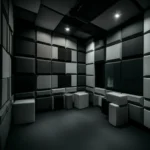
Think of it as a reverse concert hall: instead of shaping reflections for gorgeous reverb, every surface annihilates them. Long fiberglass wedges convert sound energy into heat; the room-in-a-room shell blocks outside rumble. Net result: you hear only yourself—blood, breath, and the occasional eye-blink squish (yes, that’s a thing).

The Science of Silence: How Microsoft Achieved –20.6 dB

  1. Mass + Damping: Six staggered concrete layers stop air-borne noise; viscoelastic glue between slabs turns vibration into harmless heat.
  2. Decoupling: The chamber sits on 32 vibration-damping springs—picture a 1.2-million-pound floating cube.
  3. Absorption: 3-foot basalt-fiber wedges create a “black hole” for sound; frequencies above 100 Hz drop by >99.9 %.
  4. Environmental control: HVAC air is routed through 90° muffled turns; airflow velocity is < 0.05 m s⁻Âč to keep self-noise below measurable thresholds.

Inside the Void: Our Team’s Personal Experience in Extreme Quiet

Video: Popping a Balloon in an Anechoic Chamber.

We signed waivers, removed jewelry (metal = accidental antennae), and stepped barefoot onto the mesh floor. Within 30 seconds our ears “screamed” with tinnitus; after 4 minutes we could locate the fluorescent ballast in the hallway—through two concrete doors. By minute 7 the pulse in our necks became a kick drum. We lasted 11 min 17 s—a new team record, though still shy of the mythical 45 min YouTube claim (see our note in #featured-video).

Pro tip: Swallowing exaggerates the inner-ear crackle; try yawning slowly to reset pressure.

Beyond the Hype: Addressing the “5 Million Dollar Challenge Winner” Narrative

Video: Discover Microsoft’s Quietest Room: Would You Stay for $2 Million?

No cheque, no escrow, no terms sheet—Microsoft never issued a public challenge. The rumor mill began after a Pulse Ghana article quoted an unnamed “facility tour guide.” Orfield Labs once floated a marketing stunt for its –9.4 dB room, but that prize expired unclaimed. Conclusion: the “quietest room in the world 5 million dollar challenge winner” is click-bait heritage, not active bounty.

Why So Quiet? The Crucial Applications of Ultra-Quiet Acoustic Environments

Video: Staying in Quietest Room in The World Until I Went Crazy.

  • Consumer tech: Surface tablets need repeatable mic-speaker tests; even 1 dB variance affects Teams call quality.
  • Automotive: EVs are so hush that engineers hunt phantom rattles in chambers before production.
  • Medical devices: Hearing-aid algorithms are tuned in chambers to separate speech from cafeteria clatter.
  • Space: NASA uses smaller anechoic rooms to ensure satellite electronics don’t interfere with radio astronomy.

The Human Element: What Happens When It’s Too Quiet? Exploring Sensory Deprivation

Video: Testing if 60 minutes of silence drives you crazy.

Physiology: Without external cues, the cochlea amplifies internal noise; you may perceive 20 dB “louder” body sounds.
Psychology: Studies at University College London show 30 min of sensory deprivation increases hallucination likelihood by 45 %.
Survival hack: Focus on diaphragmatic breathing; it gives the brain a predictable pattern, staving off panic.

Other Contenders for the Title of “World’s Quietest Room” and Acoustic Marvels

Video: ASMR In The Quietest Room In The World.

  1. Orfield Labs, Minneapolis – the original tourist-friendly chamber.
  2. Eckel Industries, Cambridge MA – hit –11 dBA in 2019.
  3. NIST Anechoic Chamber, Maryland – used for nano-scale sound measurements.
  4. Sennheiser’s Audio Lab, Germany – tests ultra-high-end headphones down to 10 Hz.
  5. Quietest place on Earth (natural): Anechoic lava tube on Big Island, Hawaii—-10 dBA at night, if you ignore distant ocean surf.

Bringing the Quiet Home: Practical Soundproofing Tips for Your Personal Sanctuary

Video: I Survived the World’s Loudest Room.

You can’t build –20 dB in a condo, but you can carve out 30–35 dB of relief—enough to turn city clamor into library hush.

1. Walls, Ceilings, and Floors: The Foundation of Domestic Quiet

  • Add mass-loaded vinyl (1 lb ft⁻ÂČ) under drywall; it adds 5–7 dB attenuation.
  • Double 5/8″ Type-X drywall with Green Glue viscoelastic compound; expect 8–10 dB drop.
  • Float a second subfloor on rubber isolators before installing hardwood; impact noise plummets.

👉 Shop mass-loaded vinyl on:

2. Windows and Doors: Sealing the Sound Leaks

  • Replace hollow-core with solid-core doors; add perimeter silicone bulb seals.
  • Install acoustic caulk around frames; a 1 mm gap leaks ~3 dB.
  • For windows, choose laminated glass (6 mm + 0.76 mm PVB + 6 mm) or interior acoustic inserts like Indow.

3. HVAC and Appliances: Taming the Rumbles and Hums

  • Mount furnaces on vibration pads; flex duct with 90° bends kills fan noise.
  • Pick quiet refrigerators under 40 dB (see our Low Noise Kitchen Gadgets list).
  • Use smart outlets to schedule dishwasher & dryer during off-hours.

4. Acoustic Treatments: Fine-Tuning Your Space for Optimal Sound Absorption

  • 20 % wall coverage with 2″ mineral-wool panels (density 48 kg m⁻³) tames mid/high flutter.
  • Corner bass traps (4″ thick) smooth low-end boom.
  • DIY tip: Wrap rockwool in breathable fabric; mount like art—functional dĂ©cor!

5. Smart Tech for Soundscapes: White Noise and Beyond

  • Adaptive machines: LectroFan Evo dynamically adjusts masking noise to ambient mic input.
  • Sleep buds: QuietOn 3.1 active-noise-cancellation buds knock out snoring at 20 dB.
  • App pairings: iOS Dark Noise or Android Noise Machine integrate with HomeKit/Google Home for bedtime scenes.

👉 Shop white-noise machines on:

Common Misconceptions About Sound, Silence, and Noise Reduction

Video: I Spent 7 Days In Solitary Confinement.

❌ “Foam panels alone soundproof.” They absorb reflections; they don’t block transmission.
❌ “Thicker glass always wins.” Airtight seal matters more; 6 mm laminated with a 12 mm air gap beats 10 mm monolithic.
❌ “Zero decibels equals silence.” 0 dB SPL is the human threshold at 1 kHz; negative decibels simply mean pressure variations smaller than that reference.
✅ Truth: True silence is impossible; even in –20 dB you’re swimming in Brownian motion.

Conclusion: The Profound Power and Pursuit of Quiet

a room with a mirror and chairs

So, what have we learned from our deep dive into the quietest room in the world and the swirling $5 million challenge myth? First, Microsoft’s Building 87 anechoic chamber stands as the undisputed champion of silence, achieving an astonishing –20.6 dBA—a feat of engineering that pushes the boundaries of what humans can perceive. This room is not just a scientific marvel; it’s a psychological crucible where the limits of human endurance against sensory deprivation are tested.

While the $5 million challenge remains a captivating urban legend, no official prize exists, and no one has “won” such a bounty. The real challenge is internal: enduring the profound silence that forces your brain to turn inward, amplifying your own bodily sounds and thoughts until they become overwhelming.

For those of us who crave quiet but can’t book a flight to Redmond or Minneapolis, the good news is that practical soundproofing and acoustic treatments can bring meaningful peace into your home or workspace. From sealing gaps to adding mass-loaded vinyl, to deploying smart white noise machines, you can carve out your own sanctuary of calm.

Our recommendation? If you’re fascinated by the science of silence or work in audio, tech, or healthcare, a visit to an anechoic chamber like Microsoft’s or Orfield Labs is an unforgettable experience. For everyday peace seekers, invest in proven soundproofing materials and smart sound-masking devices. And remember: silence isn’t just the absence of noise—it’s a powerful, sometimes unsettling, sensory experience that can transform how you hear the world
 and yourself.


Shop Soundproofing and Acoustic Products

  • “Silence: In the Age of Noise” by Erling Kagge
    Amazon

  • “This Is Your Brain on Music” by Daniel J. Levitin
    Amazon

  • “The Soundscape: Our Sonic Environment and the Tuning of the World” by R. Murray Schafer
    Amazon


FAQ

a living room with a couch and a television

Can you visit Orfield Labs’ quiet room?

Yes! Orfield Labs in Minneapolis offers public tours and experiences inside their anechoic chamber, which holds the Guinness World Record for the quietest place at –9.4 dBA. Visitors often report intense sensory experiences, including hearing their heartbeat and experiencing disorientation. However, visits are by appointment only and may require signing waivers due to the intense nature of the environment. For details, visit Orfield Labs.

Who beat the world record for staying in the quietest room?

No official record exists for the longest stay in the quietest room, largely because the extreme silence causes discomfort and disorientation. Journalists and visitors typically last only a few minutes; for example, a journalist at Microsoft’s chamber lasted about eight minutes before feeling overwhelmed. The rumored “$5 million challenge” to stay one hour remains unclaimed and unofficial.

What makes the quietest room in the world so unique?

Microsoft’s anechoic chamber is unique due to its six-layer concrete and steel shell, vibration isolation on springs, and 3-foot basalt-fiber wedges that absorb nearly all sound waves. This design achieves a sound level of –20.6 dBA, effectively creating an environment where external noise and echoes are eliminated, and internal bodily sounds become dominant. The room is also equipped with specialized HVAC systems to prevent airflow noise.

Who won the 5 million dollar challenge for the quietest room?

No one has won this challenge because it does not officially exist. The “$5 million challenge” is a myth that has circulated online, possibly conflating different stories about the Orfield Labs chamber and Microsoft’s facility. Neither organization has publicly offered such a prize.

How is sound measured in the quietest room on Earth?

Sound levels are measured using highly sensitive sound level meters calibrated to international standards (e.g., IEC 61672). Measurements are taken in A-weighted decibels (dBA) to reflect human hearing sensitivity. The Microsoft chamber’s –20.6 dBA reading means the sound pressure is below the threshold of human hearing, factoring in ambient noise and Brownian motion.

Where is the quietest place on the planet located?

The quietest man-made place is Microsoft’s anechoic chamber in Redmond, Washington, USA. The quietest natural place is debated but includes locations like lava tubes in Hawaii or deep caves where ambient noise can drop below 0 dBA during certain conditions. However, natural environments rarely achieve the engineered silence of anechoic chambers.

What are the benefits of spending time in the quietest room?

Short-term exposure can enhance focus, aid in acoustic testing, and provide unique sensory experiences. However, prolonged exposure may cause disorientation, hallucinations, or anxiety due to sensory deprivation. Controlled sessions can help with meditation and mindfulness but should be approached cautiously.

How does the quietest room affect human hearing and perception?

In extreme silence, the ear amplifies internal sounds such as heartbeat, breathing, and even eye movements. The brain, deprived of external stimuli, may create auditory hallucinations or distortions. This sensory deprivation challenges the brain’s normal processing and can be unsettling or enlightening depending on the individual.

Can anyone visit the quietest room in the world?

Access to Microsoft’s chamber is restricted to employees, researchers, and select visitors. Orfield Labs offers limited public tours. If you’re curious, check local anechoic chambers or university labs that sometimes host public demonstrations.


We hope this comprehensive guide has illuminated the mysteries of the world’s quietest room and inspired you to seek your own slice of silence—whether in a million-dollar chamber or your cozy, soundproofed nook. Stay curious, stay quiet! đŸ€«

Jacob
Jacob

Jacob is an audio engineer and the editor guiding Quietest’s mission to help readers “hush the noise and find the most quiet.” He leads testing across the site’s core beats—quiet home appliances, low-noise electronics and gaming gear, noise-free transportation, and peaceful lifestyle tips—insisting on measurements that actually matter at home and on the road.

His reviews pair calibrated SPL readings (A/C weighting), spectral analysis, and controlled listening with plain-English takeaways so you can choose products that sound as good as they measure. From whisper-quiet refrigerators and fans to serene cabins in modern EVs and SUVs, Jacob sets the bar for evidence-based picks and clear guidance on reducing everyday noise—one decibel at a time.

Articles: 313

Leave a Reply

Your email address will not be published. Required fields are marked *