Support our educational content for free when you purchase through links on our site. Learn more
12 Quietest Cars of All Time: Hear the Difference 🔇

The Bentley Bentayga V-8 is the quietest car in our measured lineup, registering 61 dBA in a published highway comparison. Close behind are the Rolls-Royce Cullinan, Rolls-Royce Spectre, BMW iX, and Audi e-tron Sportback—proof that exceptional cabin quiet can come from both refined gas engines and electric power.
But a decibel figure isn’t the whole story. We’ve found that a low rumble can feel more tiring than a higher, softer hush, and that changing to larger wheels can make an otherwise serene car suddenly sound busy. So we compare the numbers, the noise character, and what you should listen for on a test drive.
Key Takeaways
- The 2019 Bentley Bentayga V-8 leads the cited comparison at 61 dBA; the Rolls-Royce Cullinan follows at 62 dBA.
- The Rolls-Royce Spectre, BMW iX xDrive50, and Audi e-tron Sportback each recorded 63 dBA in the same published comparison.
- Electric cars aren’t automatically quieter at highway speeds. Tire and wind noise can become more noticeable when engine sound disappears.
- Test the exact trim and wheel-and-tire setup you plan to buy. Road surface, speed, tires, and test conditions all affect cabin noise.
- Our picks span more than luxury SUVs: the list also covers a minivan, family SUVs, an electric compact SUV, a hybrid pickup, and luxury sedans.
Table of Contents
- ⚡️ Quick Tips and Facts About the Quietest Cars
- 🔇 How Quiet Cars Are Designed: Cabin Noise, Vibration, and Soundproofing
- 📜 A Brief History of Quiet Cars and Automotive NVH
- 🏆 12 of the Quietest Cars of All Time
- 1. Rolls-Royce Spectre: An Exceptionally Silent Electric Coupé
- 2. Rolls-Royce Cullinan: A Whisper-Quiet Luxury SUV
- 3. Bentley Bentayga V-8: Refined Power With Minimal Road Noise
- 4. BMW iX xDrive50: A Serene, High-Tech Electric SUV
- 5. Audi e-tron Sportback: Quiet Electric Luxury on the Highway
- 6. 2025 Honda Odyssey Elite: A Peaceful Minivan for the Whole Family
- 7. 2021 Ford F-150 Lariat PowerBoost 4×4: A Quiet Hybrid Pickup
- 8. 2019 Subaru Ascent Touring: A Quiet Mid-Size SUV
- 9. 2024 Chevrolet Equinox EV 2LT AWD: Quiet Comfort in a Compact SUV
- 10. 2020 Buick Encore GX: A Quiet-Riding Subcompact SUV
- 11. Lexus LS: The Benchmark for a Quiet Luxury Sedan
- 12. Mercedes-Benz S-Class: A Sanctuary for Long-Distance Driving
- 📊 How We Compare Cabin Quietness: Decibels, Road Tests, and Real-World Driving
- What dB(A) Measurements Can—and Can’t—Tell You
- Road Noise, Wind Noise, Tire Noise, and Powertrain Noise
- Why Test Results Differ Between Reviews
- 🔋 Are Electric Cars Quieter Than Gas Cars?
- The Trade-Off: Less Engine Noise, More Tire and Wind Noise
- Hybrid Cars and Quiet Low-Speed Driving
- 🚘 What Makes a Car Quiet? Key Features to Look For
- Acoustic Glass and Sound-Deadening Materials
- Tires, Wheels, and Suspension Design
- Cabin Seals, Aerodynamics, and Active Noise Cancellation
- 🛣️ Choosing the Quietest Car for Your Needs
- Quietest Cars for Highway Comuting
- Quietest Cars for Families and Minivan Travel
- Quietest SUVs, EVs, Hybrids, and Pickup Trucks
- Quiet Cars for Sensitive Hearing and Long Drives
- 🧪 How to Test a Car’s Cabin Noise on a Test Drive
- 🛠️ How to Make Your Current Car Quieter
- Reduce Tire and Road Noise
- Find Wind Leaks, Worn Seals, and Loose Trim
- When Soundproofing or Repairs Are Worth It
- ❓ Frequently Asked Questions About Quiet Cars
- What is the quietest car of all time?
- What is the quietest car at highway speeds?
- Are electric cars always quieter inside?
- Which affordable cars have quiet cabins?
- Do larger wheels make a car noisier?
- Can you measure cabin noise with a phone?
- ✅ Conclusion: Finding the Quietest Car for Your Drive
- 🔗 Recommended Links
- ❔ FAQ
- 📚 Reference Links
⚡️ Quick Tips and Facts About the Quietest Cars
If you’re comparing the quietest cars of all time, start with our Quietest cars guide—then remember that “quietest” depends on how, where, and at what speed a car was measured. 🔇
Quick facts
| What to know | Why it matters |
|---|---|
| Lower cabin dBA means quieter measured sound | A reading is useful only when test speed, road surface, tires, weather, and measurement method are comparable. |
| A steady 70-mph cruise is a common comparison point | Car and Driver’s published figures use interior sound levels measured during a steady highway cruise. |
| The 2019 Bentley Bentayga V-8 recorded 61 dBA | It leads the cited production-car measurements, but that does not make it the quietest car ever built under every test condition. |
| Several luxury and electric vehicles cluster around 63 dBA | The Rolls-Royce Spectre, Audi e-tron Sportback, and BMW iX xDrive50 illustrate how different powertrains can deliver similarly hushed cabins. |
| EVs are not automatically quieter at speed | With less engine noise, tire roar and wind hiss can become more noticeable. |
| Tires and wheels can change the experience | Larger wheels and performance tires can make a cabin busier, even in a premium car. |
| Test-drive the exact trim you plan to buy | Wheel size, tire model, glass, and equipment can vary within the same model line. |
Car and Driver’s list reports 61 dBA for the Bentayga, 62 dBA for the Cullinan, and 63 dBA for the Audi e-tron Sportback, BMW iX xDrive50, and Rolls-Royce Spectre. Those are valuable comparison figures—not a universal leaderboard—because vehicle tests can use different tires, roads, and conditions. See Car and Driver’s quiet-car comparison.
Our reviewer’s rule: A number tells you how loud a cabin was in one test. Your ears tell you whether the sound is a low, forgetable hush or annoying whistle you’ll notice on every commute.
Want to know why the loudest thing in a nearly silent EV can be its tires? We’ll get to that after looking at the cars themselves.
🔇 How Quiet Cars Are Designed: Cabin Noise, Vibration, and Soundproofing
Automotive engineers group cabin harshness under NVH: noise, vibration, and harshness. The job is not simply to make the engine quieter. Engineers must stop sound and vibration from reaching you through the air, body structure, glass, seats, steering wheel, and floor.
The main sources of cabin noise
| Noise source | What you may hear | Common ways automakers reduce it |
|---|---|---|
| Powertrain | Engine, transmission, motor, fuel-cell compressor | Isolation mounts, acoustic covers, active sound control, smoother power delivery |
| Tires and road | Broadband roar, thumps, gravel hiss | Quiet-tread tires, wheel-well liners, floor insulation, suspension tuning |
| Wind | Whistling around mirrors, windows, or roof seals | Aerodynamic shaping, careful mirror design, tighter seals, acoustic glass |
| Structure | Low-frequency boom or vibration | Stiffer body structures, tuned dampers, sound-deadening materials |
| Accessories | HVAC fan, pumps, relays, warning chimes | Quieter components, careful placement, better sound calibration |
Why “quiet” is more than a decibel reading
A cabin can measure well and still feel tiring. A steady low-frequency drone may bother one passenger more than a somewhat higher, softer wash of tire noise. Whistles and rattles are especially noticeable because they break the cabin’s sound pattern.
We listen for:
- Overall level: How much sound reaches the occupants?
- Frequency: Is it a low rumble, midrange buzz, or high-pitched hiss?
- Variation: Does the noise surge with speed, road texture, or acceleration?
- Intrusion: Can passengers speak naturally without raising their voices?
- Character: Is the sound smooth, or does one irritating tone dominate?
This is why a calm cabin can feel quieter than its meter reading suggests. It’s also why luxury brands spend so much effort on the quality of silence, not just its measured level.
📜 A Brief History of Quiet Cars and Automotive NVH
For much of motoring history, quietness was an expensive luxury. Better body sealing, heavier insulation, refined engines, and improved suspension all added cost and complexity. Rolls-Royce helped make near-silent travel part of its identity, while other manufacturers gradually brought acoustic refinement to family cars and SUVs.
Then electric drivetrains changed the soundtrack. Remove combustion and the cabin loses much of the familiar engine noise—but the quiet also exposes sounds that an engine used to mask. Tire noise, wind, pumps, and motor whine suddenly get a solo.
From combustion refinement to electric silence
Early electric and hydrogen prototypes made silence an engineering showcase. But quiet propulsion alone did not guarantee a quiet cabin at highway speed. The road and the air still had plenty to say.
A recent retrospective of experimental cars describes projects such as the Rolls-Royce 102EX, MINI E, Volkswagen Golf Blue-E-Motion, and GM Hy-wire. They explored battery-electric and fuel-cell power, but were tested in different conditions and do not form a standardized decibel ranking. Read the DAX Street overview of nine tested, non-production cars.
A useful distinction: Prototype anecdotes tell us what technologies were promising. Repeatable measurements tell us which production cars were quieter in a particular test.
🏆 12 of the Quietest Cars of All Time
This is a curated guide to notably quiet production vehicles, combining published highway measurements, model-specific features, and vehicle-category coverage. It is not a claim that all 12 were measured on the same day, road, tires, or instrument.
Published figures below are from Car and Driver’s cited comparisons where available. For models without a figure in that comparison, we describe their quiet-car credentials without inventing a measurement.
| Rank | Vehicle | Type | Reported cabin sound | Best for |
|---|---|---|---|---|
| 1 | 2019 Bentley Bentayga V-8 | Luxury SUV | 61 dBA | Exceptional highway refinement |
| 2 | 2019 Rolls-Royce Cullinan | Ultra-luxury SUV | 62 dBA | Maximum isolation and comfort |
| 3 | 2020 Audi e-tron Sportback | Electric luxury SUV | 63 dBA | Quiet electric cruising |
| 4 | BMW iX xDrive50 | Electric luxury SUV | 63 dBA | Spacious, tech-rich electric comfort |
| 5 | 2024 Rolls-Royce Spectre | Electric luxury coupé | 63 dBA | Hushed electric grand touring |
| 6 | 2025 Honda Odyssey Elite | Minivan | 66 dBA | Family road trips |
| 7 | 2021 Ford F-150 Lariat PowerBoost 4×4 | Hybrid pickup | 64 dBA | Quiet capability and utility |
| 8 | 2019 Subaru Ascent Touring | Mid-size SUV | 65 dBA | Three-row all-weather family travel |
| 9 | 2024 Chevrolet Equinox EV 2LT AWD | Electric compact SUV | 65 dBA | Quiet everyday EV driving |
| 10 | 2020 Buick Encore GX | Subcompact SUV | 67 dBA | A smaller SUV with a calm cabin |
| 11 | Lexus LS | Luxury sedan | Not listed in this comparison | Traditional luxury-sedan serenity |
| 12 | Mercedes-Benz S-Class | Luxury sedan | Not listed in this comparison | Long-distance comfort and isolation |
1. Rolls-Royce Spectre: An Exceptionally Silent Electric Coupé
The Rolls-Royce Spectre pairs an all-electric drivetrain with the marque’s focus on quiet, smooth progress. Car and Driver reported 63 dBA in its comparison and noted that the test car’s optional 23-inch wheels may have influenced the result. The same report describes a full-throttle reading of 65 dBA, a reminder that strong acceleration does not necessarily turn the cabin into a concert venue.
What stands out
- Electric propulsion removes combustion-engine noise and vibration.
- A grand-touring layout prioritizes comfort over sharp, noisy responses.
- Large optional wheels can compromise the hush over rough surfaces.
Trade-off: “Electric” does not mean soundless. Tire contact, wind, and drivetrain components remain audible, particularly when you accelerate hard.
Explore the Rolls-Royce Spectre
2. Rolls-Royce Cullinan: A Whisper-Quiet Luxury SUV
The 2019 Rolls-Royce Cullinan recorded 62 dBA in the cited comparison. Its twin-turbo V-12 still makes power, of course, but the engineering goal is to keep the engine from dominating the cabin during ordinary cruising.
Why it earns a place
- Substantial cabin isolation and a comfort-focused ride help filter road disturbances.
- The engine is designed to feel unobtrusive during relaxed driving.
- Its SUV body offers a high seating position and generous passenger space.
The catch: A quiet luxury SUV is still sensitive to tires, wheel choice, and road surface. Big wheels look imposing; coarse pavement may return the favor.
Explore the Rolls-Royce Cullinan
3. Bentley Bentayga V-8: Refined Power With Minimal Road Noise
The 2019 Bentley Bentayga V-8 tops the cited production-car measurements at 61 dBA. Car and Driver notes that its 542-horsepower twin-turbo V-8 fades into the background at cruising speed. That’s an impressive trick: substantial performance without making every trip sound like a track session.
Strengths
- Excellent isolation for highway travel.
- A powerful engine that can stay subdued when you are not asking for maximum output.
- A luxury interior and ride tuned for long-distance comfort.
Potential drawback: Performance tires and larger wheels can increase road noise. When you shop a used Bentayga, inspect the exact wheel-and-tire setup rather than assuming every trim is equally serene.
4. BMW iX xDrive50: A Serene, High-Tech Electric SUV
The BMW iX xDrive50 measured 63 dBA in the cited comparison. Its electric drivetrain avoids the steady engine soundtrack of a gasoline SUV, while the spacious cabin and soft-touch interior help deliver a composed long-distance feel.
What we like
- Smooth electric acceleration without gear changes.
- A roomy cabin suited to passengers who value conversation and comfort.
- A premium interior that feels designed for quiet travel.
What to listen for: The motor may be subtle, but tire and wind noise can become more prominent as speed rises. Test it on both smooth asphalt and a rougher stretch.
5. Audi e-tron Sportback: Quiet Electric Luxury on the Highway
The 2020 Audi e-tron Sportback also recorded 63 dBA. Car and Driver identifies it as the quietest EV in its list at the time. It combines electric power with a premium cabin, showing that an EV can be relaxing at highway speed when road and wind noise are properly managed.
Benefits
- Calm, smooth electric driving.
- A refined cabin suitable for commuting and longer trips.
- No conventional combustion-engine rumble.
Consider before buying: Model years, tire choices, and successor vehicles differ. Check the exact version and equipment rather than treating every e-tron as acoustically identical.
Explore Audi’s electric vehicle lineup
6. 2025 Honda Odyssey Elite: A Peaceful Minivan for the Whole Family
The 2025 Honda Odyssey Elite recorded 66 dBA in the cited category comparison. A quieter cabin is especially useful in a minivan: it makes conversation easier, helps passengers relax, and may even let the driver hear the tiny plastic toy rolling under the third row. A different kind of road-test soundtrack. 🧸
Family-friendly advantages
- A broad, practical cabin for multiple rows of passengers.
- Comfortable road-trip layout and a smooth ride.
- Lower cabin noise than many shoppers expect from a family hauler.
Drawbacks to check: Cabin noise can rise with a full load, roof accessories, rough pavement, or aging tires. Take the whole crew on the test drive if possible; the third row has its own opinion.
7. 2021 Ford F-150 Lariat PowerBoost 4×4: A Quiet Hybrid Pickup
The 2021 Ford F-150 Lariat PowerBoost 4×4 recorded 64 dBA in the cited comparison. Its hybrid system combines a 3.5-liter V-6 with an electric motor, delivering strong output while allowing quieter electric operation in some conditions.
Why truck shoppers should care
- A quieter cabin makes daily commuting less tiring.
- Hybrid power can smooth low-speed driving and reduce engine-on time in suitable conditions.
- It retains the F-150’s utility rather than asking you to trade capability for comfort.
Trade-offs: A pickup’s shape, tires, bed, and drivetrain can create more wind and road noise than a sleek sedan. Tire selection matters enormously.
8. 2019 Subaru Ascent Touring: A Quiet Mid-Size SUV
The 2019 Subaru Ascent Touring measured 65 dBA in the cited category comparison. It combines three-row seating with standard all-wheel drive, giving families a practical option that is not all weather capability and road roar.
Strong points
- Three rows for family or group travel.
- Standard all-wheel drive.
- A measured cabin-noise result that compares well within its vehicle class.
What to test: Listen for tire roar on coarse pavement and check whether conversations are comfortable in the third row. A calm front seat is only half the story.
9. 2024 Chevrolet Equinox EV 2LT AWD: Quiet Comfort in a Compact SUV
The 2024 Chevrolet Equinox EV 2LT AWD recorded 65 dBA in the cited comparison. Its electric powertrain helps eliminate conventional engine noise, while its compact-SUV format provides a practical everyday footprint.
Advantages
- Electric acceleration without combustion-engine rumble.
- A cabin-noise result that stands out for a compact SUV.
- Useful space for commuting, errands, and small-family duties.
Limitations: The quietness you hear depends on road texture and tires. An EV may make tire hiss more obvious because there is less engine noise to cover it.
Explore the Chevrolet Equinox EV
10. 2020 Buick Encore GX: A Quiet-Riding Subcompact SUV
The 2020 Buick Encore GX recorded 67 dBA in the cited subcompact-SUV comparison. It is not as hushed as the top luxury vehicles, but its inclusion matters: cabin refinement is not limited to huge, high-end SUVs.
Good fit for
- Drivers who want a smaller SUV that is easier to park.
- Comuters who value a calmer cabin in everyday traffic.
- Shoppers seeking a more approachable alternative to large luxury models.
Check the specific car: Tire condition and trim equipment can alter cabin noise. On a used example, listen for wind leaks, worn seals, and suspension rattles.
11. Lexus LS: The Benchmark for a Quiet Luxury Sedan
The Lexus LS is a natural sedan to consider if you want a low, isolated cabin and a refined ride. It is included here as a luxury-sedan reference point, not as a vehicle with a directly comparable figure in the Car and Driver measurements above.
What makes it worth a test drive
- A sedan body can offer a more streamlined highway profile than many SUVs.
- Lexus emphasizes comfort and refinement in the LS.
- The low seating position and long-wheelbase design suit relaxed cruising.
Our advice: Compare a gasoline LS and hybrid LS carefully if both are under consideration. Powertrain, wheel, and tire configurations may change the sound character.
12. Mercedes-Benz S-Class: A Sanctuary for Long-Distance Driving
The Mercedes-Benz S-Class belongs on a shortlist for drivers who prize a quiet, comfortable luxury sedan. Like the Lexus LS, it is a model recommendation rather than a direct entry in the cited measurement table.
Why consider it
- Designed around long-distance comfort and passenger refinement.
- A sedan profile can help limit wind exposure compared with a tall SUV.
- Luxury features and sound insulation are intended to create a composed cabin.
Be realistic: The precise experience changes with model year, wheel size, tire type, and road surface. A test drive is still the best acoustic measurement device you own.
Explore the Mercedes-Benz S-Class
📊 How We Compare Cabin Quietness: Decibels, Road Tests, and Real-World Driving
What dB(A) Measurements Can—and Can’t—Tell You
dB(A) is a sound-level measurement weighted to approximate how human hearing responds to different frequencies. It is useful for comparing sound levels when testing conditions are controlled—but it does not capture every quality that makes a cabin pleasant or irritating.
A figure of 63 dBA is not a promise that every version of a model will measure 63 dBA on your commute. Speed, road, tires, weather, loading, and measurement position can shift the result.
| Measurement detail | Why it matters |
|---|---|
| Speed | Wind and tire noise generally increase as speed rises. |
| Road surface | Coarse asphalt can produce far more tire roar than smooth pavement. |
| Tires | Tread pattern, compound, size, pressure, and wear affect noise. |
| Vehicle configuration | Trim and wheel options may alter glass, insulation, and tire choice. |
| Test location | A quiet smooth track and a rough public road are different acoustic environments. |
| Meter and placement | Instrument calibration and microphone location affect readings. |
For reliable comparisons, use sources that describe their method and compare vehicles tested under similar conditions. The National Institute of Standards and Technology’s sound-level information provides useful background on acoustics and measurement.
Road Noise, Wind Noise, Tire Noise, and Powertrain Noise
On a quiet road, sound sources take turns in the spotlight:
- At a stop: HVAC fans, pumps, and nearby traffic may dominate.
- At low speed: Electric motors are subdued, so tire contact and pedestrian-warning sounds may stand out.
- At highway speed: Wind and tire noise often become the main sources.
- Under acceleration: Gas engines grow louder; EV motors may produce a subtle whine.
- On rough pavement: Suspension impacts and wheel-well noise can overwhelm otherwise excellent isolation.
Why Test Results Differ Between Reviews
Different publications may measure different trims, tire packages, routes, and speeds. Even when both report dBA, they may not be measuring the same acoustic situation.
What should you trust? Use a published figure as a within-test comparison, not as a universal truth. Then test the exact model and trim you plan to drive.
🔋 Are Electric Cars Quieter Than Gas Cars?
Often at low speeds, yes. An EV has no conventional combustion engine idling beside you, and its smooth power delivery avoids the vibrations and shifts associated with many gasoline powertrains. At highway speed, the gap can shrink: wind and tires do not care what powers the wheels.
The Trade-Off: Less Engine Noise, More Tire and Wind Noise
This is the quiet-EV paradox: remove one sound source, and the remaining ones become easier to hear. A smooth, well-insulated EV can be wonderfully calm, but a heavy vehicle on wide performance tires may still produce substantial road roar.
Hybrid Cars and Quiet Low-Speed Driving
Hybrids can run quietly under some low-load conditions, but their engines may start during acceleration, cold weather, or battery charging. If you want the calmest daily experience, assess when and how often the engine runs, not only the powertrain label.
For more transportation-related sound advice, browse Quietest™’s Noise-Free Transportation category.
🚘 What Makes a Car Quiet? Key Features to Look For
Acoustic Glass and Sound-Deadening Materials
Acoustic laminated glass can reduce some outside noise, while insulation in the doors, floor, roof, and bulkhead helps control sound transmission. These features are only part of the system: poor seals or a noisy tire can undo some of the benefit.
Look for:
- Acoustic or laminated side glass where offered.
- Well-fitted door and window seals.
- Carpet and underbody insulation.
- Carefully isolated engine and drivetrain mounts.
Tires, Wheels, and Suspension Design
Tires are the part of the vehicle that touches the road—and one of the easiest ways for noise to enter the cabin.
- Ask which tire model comes on the vehicle.
- Compare standard and optional wheel sizes.
- Avoid assuming a premium tire is automatically quiet; performance priorities may differ.
- Keep pressures at the manufacturer’s recommended level.
- Replace worn or uneven tires before blaming the cabin.
Cabin Seals, Aerodynamics, and Active Noise Cancellation
Wind whistles often come from details: mirror housings, roof rails, window seals, or a slightly misaligned door. Active noise cancellation can reduce certain low-frequency sounds, but it is not magic. It will not erase every sharp impact, high-pitched whistle, or loose trim rattle.
For practical ways to reduce unwanted sound around your home and vehicle, see Quietest™’s Noise Reduction Tips.
🛣️ Choosing the Quietest Car for Your Needs
The right choice depends on where you drive, who rides with you, and which sounds bother you most.
Quietest Cars for Highway Comuting
For long motorway runs, prioritize:
- Low measured cabin noise at a stated cruise speed.
- Comfortable seats and a suspension that controls repeated impacts.
- A calm sound profile without wind whistles or tire drones.
- A test drive on the actual road surface you use most.
The Bentayga, Cullinan, Spectre, BMW iX, and Audi e-tron Sportback are strong candidates in the cited comparison. But a quiet sedan may suit you better than a large SUV if wind noise and vehicle height are concerns.
Quietest Cars for Families and Minivan Travel
A family vehicle should be quiet in all rows, not just at the driver’s seat. Test with passengers or luggage if possible. Check whether the third row can hold a conversation at highway speed and whether rear HVAC fans are intrusive.
The Honda Odyssey and Subaru Ascent stand out in their respective categories in the cited figures. The right answer depends on whether you need a minivan’s flexible interior or an SUV’s ground clearance and all-wheel-drive setup.
Quietest SUVs, EVs, Hybrids, and Pickup Trucks
| If you need… | Start by considering… | Listen closely for… |
|---|---|---|
| Ultra-luxury SUV | Bentley Bentayga, Rolls-Royce Cullinan | Tire roar from large wheels |
| Electric luxury SUV | BMW iX, Audi e-tron Sportback | Wind and tire noise at speed |
| Family three-row SUV | Subaru Ascent | Third-row sound and rough-road impacts |
| Compact electric SUV | Chevrolet Equinox EV | Tire hiss on coarse pavement |
| Hybrid pickup | Ford F-150 PowerBoost | Wind noise, tire choice, and engine transitions |
| Family minivan | Honda Odyssey | Rear-row conversation and loaded-cabin noise |
For first-hand-style comparative video context, the featured video on quiet compact SUVs, “Top 10 Quietest Compact SUVs! — Sound Level dB Readings for Every Model!” by Car Confections, compares sound-level readings across tested models. It can help you see how compact SUVs stack up, but always check its test conditions and do not compare its figures directly with another outlet’s unless the methods match.
Quiet Cars for Sensitive Hearing and Long Drives
If sound sensitivity, tinnitus, or fatigue is part of your decision, prioritize sound character and comfort, not just a single number. A short test drive may not reveal the low-frequency drone that becomes tiring after two hours.
Try this:
- Drive at your normal cruising speed.
- Turn off the stereo and listen for a few minutes.
- Check different road surfaces.
- Sit in every seat you regularly use.
- Test climate control at the fan speed you need.
- Consider a professional test drive or extended rental before committing.
Quiet surroundings matter in other parts of life, too. Our guides to Quiet Electronics and Low Noise Household Items cover products that help keep home and work spaces calmer.
🧪 How to Test a Car’s Cabin Noise on a Test Drive
A showroom is acoustically flattering. It is carpeted, stationary, and rarely includes a truck passing at 70 mph. Use this step-by-step test instead:
- Choose the exact trim and wheels. A different tire package can change the cabin sound.
- Drive the route you know. Include a smooth road, rough pavement, and highway if safe.
- Switch off music and podcasts. Give your ears a chance to notice background noise.
- Test at several speeds. Listen for a noise that appears at a particular speed or acceleration level.
- Check each seat. Rear passengers may hear different tire or wind noise.
- Try climate control settings. The fan can mask or reveal other sounds.
- Listen for specific problems. Note rattles, whistles, booming, vibration, and motor whine.
- Repeat the test. A second drive helps separate a genuine cabin trait from a passing truck or gust of wind.
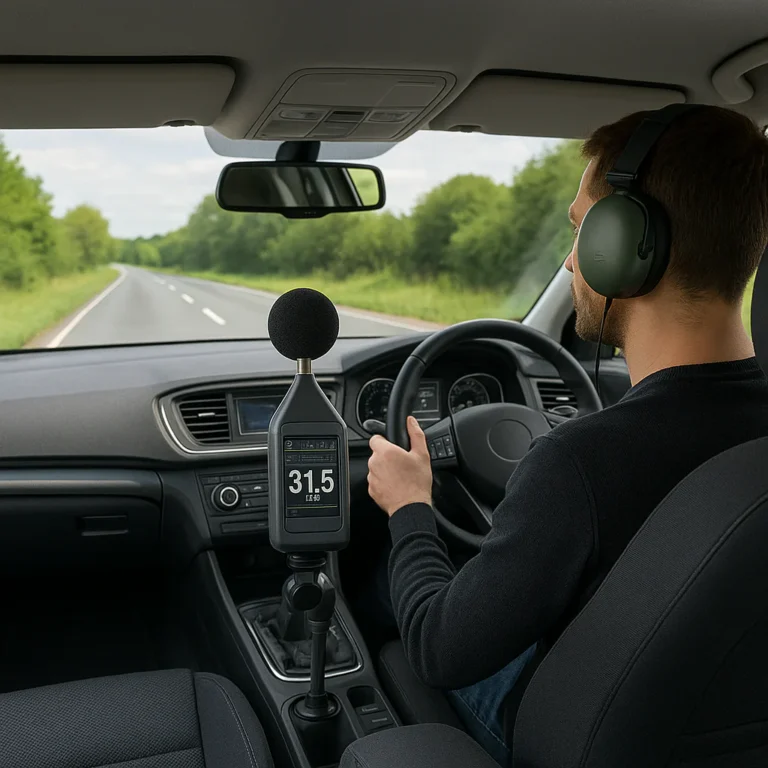
A phone sound-meter app can give a rough comparison between two cars, but it is not a calibrated substitute for a proper meter. Hold the phone in the same position, use the same route and speed, and treat the result as a clue—not a verdict.
🛠️ How to Make Your Current Car Quieter
Before adding sound-deadening material, find the source. A worn tire, loose shield, or failed door seal may be the actual culprit.
Reduce Tire and Road Noise
- Check tire pressure against the vehicle placard.
- Inspect for uneven wear, cupping, or damage.
- Ask a tire specialist about quieter replacement tires suited to your vehicle.
- Avoid changing wheel size without considering tire sidewall and comfort.
- Have suspension or wheel-bearing problems checked promptly.
Find Wind Leaks, Worn Seals, and Loose Trim
At a safe stop, inspect door and window seals for damage or gaps. A persistent whistle can also come from roof accessories, mirror trim, or a poorly fitted replacement windshield. Do not tape over a suspected safety or water-leak issue; have a qualified technician diagnose it.
When Soundproofing or Repairs Are Worth It
Professional acoustic treatment can help, but adding material everywhere is not a cure-all. Some noises travel through suspension components or body structures rather than through a simple open cavity. Get the car checked for mechanical issues first.
For broader low-noise product ideas, browse Quietest™’s Low Noise Kitchen Gadgets and Noise Reduction Tips. For a vehicle, however, repair and tire selection should come before DIY insulation experiments.
❓ Frequently Asked Questions About Quiet Cars
What is the quietest car of all time?
There is no universally verified “quietest car ever” record that covers every production vehicle under identical conditions. In Car and Driver’s cited production-car comparison, the 2019 Bentley Bentayga V-8 measured 61 dBA at a steady highway cruise, the lowest figure in that list. That makes it the measured leader in that comparison—not an indisputable all-time champion.
What is the quietest car at highway speeds?
Among the models in the cited comparison, the 2019 Bentley Bentayga V-8 had the lowest reported figure at 61 dBA. The Rolls-Royce Cullinan followed at 62 dBA, while the Spectre, BMW iX xDrive50, and Audi e-tron Sportback were reported at 63 dBA. Because test methods and conditions differ, compare figures only when the source’s procedures are clear.
Are electric cars always quieter inside?
No. Electric cars generally avoid combustion-engine noise and can be especially quiet at low speeds. At highway speed, tire and wind noise can dominate, and some EVs produce audible motor or accessory sounds. The quietest result depends on the entire vehicle—body design, insulation, tires, glass, and road surface—not just the drivetrain.
Which affordable cars have quiet cabins?
A quieter cabin does not require an ultra-luxury badge. In the cited category comparison, the 2020 Buick Encore GX recorded 67 dBA, while the 2024 Chevrolet Equinox EV 2LT AWD recorded 65 dBA. These measurements come from different vehicle classes and should not be treated as direct head-to-head results. Test the specific trim and tires before deciding.
Do larger wheels make a car noisier?
They can. Larger wheels often come with lower-profile tires, which may transmit more impacts and road texture into the cabin. The result depends on the tire design, suspension, and vehicle setup, so it is not automatic. Test the standard and optional wheel packages on the same type of pavement if possible.
Can you measure cabin noise with a phone?
You can use a phone app for a rough, repeatable comparison, but phone microphones and apps are not all calibrated alike. Keep the phone in the same place, drive the same route at the same speed, and avoid treating the reading as a certified measurement. For accurate testing, use a calibrated sound-level meter and controlled conditions.
What makes one quiet cabin feel more comfortable than another?
Sound level is only part of the experience. A steady low rumble, a sharp whistle, and a soft broadband hiss can be equally noticeable on a meter but feel very different to occupants. Listen for tone, variation, and how well the cabin lets you talk without raising your voice.
Are prototype cars quieter than production cars?
Some prototypes have been described as exceptionally quiet, especially electric and hydrogen-fuel-cell demonstrators. But the Rolls-Royce 102EX, MINI E, GM Hy-wire, and other experimental vehicles were not tested under one common protocol. Their stories reveal promising technology, not a standardized ranking against production cars.
How does a quiet car compare with the quietest places on Earth?
A quiet car is still a moving environment surrounded by tire contact, airflow, vibration, and traffic. The quietest places on Earth are a different subject: natural and engineered environments can have much lower or more stable background sound, but they are not directly comparable with a moving vehicle measured in dBA. The meaningful comparison is practical: cars reduce exposure to traffic and wind, while truly quiet environments remove many sound sources altogether.